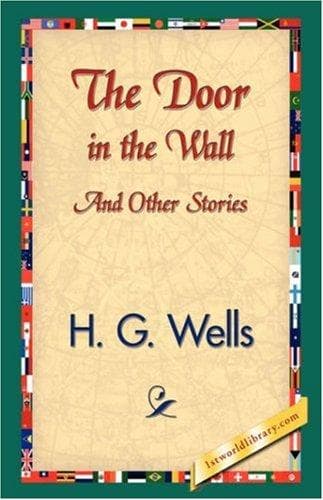
The Door in the Wall, and Other StoriesWells, H. G. (Herbert George)
Science
The Door in the Wall, and Other Stories
Wells, H. G. (Herbert George)
Fantasy fiction, English; Science fiction, English; Short stories
“You see the fine effect of the railway signals towards Burslem,” said
Horrocks, suddenly breaking into loquacity, striding fast, and
tightening the grip of his elbow the while. “Little green lights and
red and white lights, all against the haze. You have an eye for effect,
Raut. It’s a fine effect. And look at those furnaces of mine, how they
rise upon us as we come down the hill. That to the right is my
pet—seventy feet of him. I packed him myself, and he’s boiled away
cheerfully with iron in his guts for five long years. I’ve a particular
fancy for _him_. That line of red there—a lovely bit of warm orange
you’d call it, Raut—that’s the puddlers’ furnaces, and there, in the
hot light, three black figures—did you see the white splash of the
steam-hammer then?—that’s the rolling mills. Come along! Clang,
clatter, how it goes rattling across the floor! Sheet tin,
Raut,—amazing stuff. Glass mirrors are not in it when that stuff comes
from the mill. And, squelch!—there goes the hammer again. Come along!”
He had to stop talking to catch at his breath. His arm twisted into
Raut’s with benumbing tightness. He had come striding down the black
path towards the railway as though he was possessed. Raut had not
spoken a word, had simply hung back against Horrocks’ pull with all his
strength.
“I say,” he said now, laughing nervously, but with an undernote of
snarl in his voice, “why on earth are you nipping my arm off, Horrocks,
and dragging me along like this?”
At length Horrocks released him. His manner changed again. “Nipping
your arm off?” he said. “Sorry. But it’s you taught me the trick of
walking in that friendly way.”
“You haven’t learnt the refinements of it yet then,” said Raut,
laughing artificially again. “By Jove! I’m black and blue.” Horrocks
offered no apology. They stood now near the bottom of the hill, close
to the fence that bordered the railway. The ironworks had grown larger
and spread out with their approach. They looked up to the blast
furnaces now instead of down; the further view of Etruria and Hanley
had dropped out of sight with their descent. Before them, by the stile
rose a notice-board, bearing still dimly visible, the words, “BEWARE OF
THE TRAINS,” half hidden by splashes of coaly mud.
“Fine effects,” said Horrocks, waving his arm. “Here comes a train. The
puffs of smoke, the orange glare, the round eye of light in front of
it, the melodious rattle. Fine effects! But these furnaces of mine used
to be finer, before we shoved cones in their throats, and saved the
gas.”
“How?” said Raut. “Cones?”
“Cones, my man, cones. I’ll show you one nearer. The flames used to
flare out of the open throats, great—what is it?—pillars of cloud by
day, red and black smoke, and pillars of fire by night. Now we run it
off in pipes, and burn it to heat the blast, and the top is shut by a
cone. You’ll be interested in that cone.”
“But every now and then,” said Raut, “you get a burst of fire and smoke
up there.”
Public-domain text, read in full here on John Shaqi.
Reviews
Reviews
No reviews yet
Be the first to share your thoughts on this work.
Join the Discussion
Join the discussion
Sign in to leave a comment or review.
Sign InorCreate an account