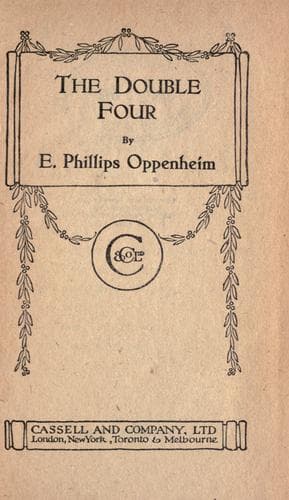
The Double FourOppenheim, E. Phillips (Edward Phillips)
General
The Double Four
Oppenheim, E. Phillips (Edward Phillips)
Secret societies -- Fiction
They climbed some broken steps. Their guide opened a door with a Yale
key. The door swung to after them and they found themselves in darkness.
There had been no light in the windows. There was no light, apparently,
in the house. Their companion produced an electric torch from his
pocket.
"You had best follow me," he advised. "Our quarters face out the other
way. We keep this end looking a little deserted."
They passed through a swing door and everything was at once changed. A
multitude of lamps hung from the ceiling, the floor was carpeted, the
walls clean.
"We don't go in for electric light," their guide explained, "as we try
not to give the place away. We manage to keep it fairly comfortable,
though."
He pushed open the door and entered a somewhat gorgeously furnished
salon. There were signs here of feminine occupation, an open piano, and
the smell of cigarettes. Once more Peter hesitated.
"Your friends seem to be in hiding," he remarked. "Personally, I am
losing my curiosity."
"Guess you won't have to wait very long," the man replied, with meaning.
The room was suddenly invaded on all sides. Four doors, which were quite
hidden by the pattern of the wall, had opened almost simultaneously, and
at least a dozen men had entered. This time both Sogrange and Peter knew
that they were face to face with the real thing. These were men who came
silently in, not cigarette-stunted youths. Two of them were in evening
dress; three or four had the appearance of prize-fighters. In their
countenances was one expression common to all--an air of quiet and
conscious strength.
A fair-headed man, in a dinner jacket and black tie, became at once
their spokesman. He was possessed of a very slight American accent, and
he beamed at them through a pair of gold-rimmed spectacles.
"Gentlemen," he said, "I am very glad to meet you both."
"Very kind of you, I'm sure," Sogrange answered. "Our friend here," he
added, indicating their guide, "found us trying to gain a little insight
into the more interesting part of New York life. He was kind enough to
express a wish to introduce us to you."
The man smiled. He looked very much like some studious clerk, except
that his voice seemed to ring with some latent power.
"I am afraid," he said, "that your friend's interest in you was not
entirely unselfish. For three days he has carried in his pocket an order
instructing him to produce you here."
"I knew it!" Peter whispered, under his breath.
"You interest me," Sogrange replied. "May I know whom I have the honour
of addressing?"
"You can call me Burr," the man announced; "Philip Burr. Your names it
is not our wish to know."
"I am afraid I do not quite understand," Sogrange said.
"It was scarcely to be expected that you should," Mr. Philip Burr
admitted. "All I can tell you is that, in cases like yours, I really
prefer not to know with whom I have to deal."
"You speak as though you had business with us," Peter remarked.
Public-domain text, read in full here on John Shaqi.
Reviews
Reviews
No reviews yet
Be the first to share your thoughts on this work.
Elsewhere in the archive
Join the Discussion
Join the discussion
Sign in to leave a comment or review.
Sign InorCreate an account