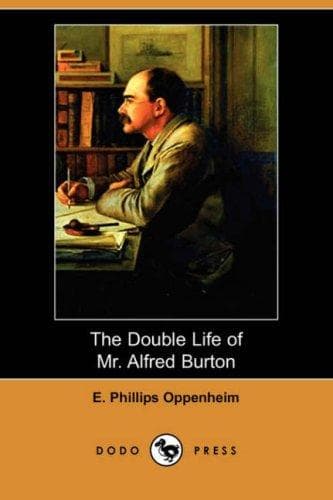
The Double Life Of Mr. Alfred BurtonOppenheim, E. Phillips (Edward Phillips)
General
The Double Life Of Mr. Alfred Burton
Oppenheim, E. Phillips (Edward Phillips)
Detective and mystery stories
"Since I saw you last," he continued, "I have been very nearly like it.
I couldn't travel alone, I bought silly comic papers, I played nap with
young men who talked of nothing but their 'shop' and their young ladies.
I have been to a public-house, drunk beer, and shaken hands with the
barmaid. I was even disappointed when one of them--a creature with
false hair, a loud, rasping voice and painted lips--was not there. Just
in time I took one of my beans and became myself again, but Edith, I
have only two more. When they are gone there is an end of me. That is
why I sit here by your side at this moment and feel myself a condemned
man. I think that when I feel the change coming I shall throw myself
over into the river. I could not bear the other life again!"
"Absurd!" she declared.
"If I believed," he went on, "that I could carry with me across that
curious boundary enough of decency, enough of my present feelings, to
keep us wholly apart, I would be happier. It is one of the terrors of
my worst moments when I think that in the months or years to come I may
again be tempted--no, not I, but Alfred Burton of Garden Green may be
tempted--to look once more across the hedge for you."
She smiled reassuringly at him.
"You do not terrify me in the least. I shall ask you in to tea."
He groaned.
"My speech will be Cockney and my manners a little forward," he said, in
a tone of misery. "If I see your piano I shall want to vamp."
"I think," she murmured, "that for the sake of the Alfred Burton who is
sitting by my side to-night, I shall still be kind to you. Perhaps you
will not need my sympathy, though. Perhaps you will adapt yourself
wholly to your new life when the time comes."
He shook his head.
"There are cells in one's memory," he muttered. "I don't understand--I
don't know how they get there--but don't you remember that time last
summer when I was picnicking with my common friends? We were drinking
beer out of a stone jug, we were singing vulgar songs, we were revelling
in the silly puerilities of a bank holiday out of doors. And I saw your
face and something came to me. I saw for a moment over the wall. Dear,
I am very sure that if I go back there will be times when I shall see
over the wall, and my heart will ache and the whole taste of life will
be like dust between my teeth."
She leaned towards him.
"It is your fault if I say this," she whispered. "It is you yourself
who have prepared the way. Why not make sure of riches? The world can
give so much to the rich. You can buy education, manners, taste.
Anything, surely, would be better than taking up the life of an
auctioneer's clerk once more? With riches you can at least get away
from the most oppressive forms of vulgarity."
"I wish I could believe it," he replied. "The poor man is, as a rule,
natural. The rich man has the taste of other things on his palate; he
has looked over the wrong wall, he apes what he sees in the wrong
garden."
Public-domain text, read in full here on John Shaqi.
Reviews
Reviews
No reviews yet
Be the first to share your thoughts on this work.
Elsewhere in the archive
Join the Discussion
Join the discussion
Sign in to leave a comment or review.
Sign InorCreate an account