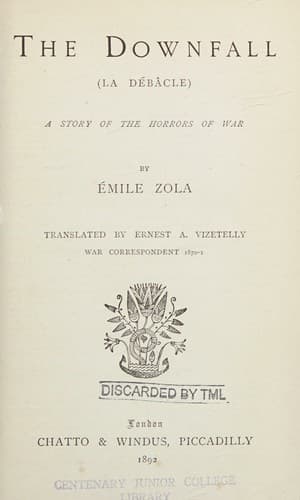
The Downfall (La Débâcle): A Story of the Horrors of WarZola, Émile
General
The Downfall (La Débâcle): A Story of the Horrors of War
Zola, Émile
Franco-Prussian War, 1870-1871 -- Fiction
Then, in passing through Raucourt there was desperate hustling and
anxiety. Ought they to turn to the right, towards Autrecourt, in view
of crossing the Meuse at Villers, as had been decided? Perplexed and
hesitating, General Douay feared that he might find the bridge there
blocked with retreating troops, perhaps even already in the power of
the Prussians. He preferred, therefore, to continue straight on through
the defile of Haraucourt, so as to reach Remilly before night. Again
had their destination been changed; after Mouzon, Villers, and after
Villers, Remilly. They were still marching due north, with the Uhlans
galloping behind them. They had now less than four miles to go, but it
was already five o'clock, and they were overwhelmingly fatigued. They
had been on foot since daybreak, and had taken twelve hours to cover
scarcely three leagues, tramping along, wearing themselves out with
endless halts, amid the liveliest emotions and fears. Moreover, during
the last two nights they had barely slept, and since leaving Vouziers
they had not been able to satisfy their hunger. They were sinking with
inanition. At Raucourt the scene was pitiable.
Raucourt is a well-to-do little town, with its numerous factories, its
well-built high street which the road follows, its coquettish-looking
church and town-hall. Only, all its resources had been exhausted;
the bakers' and grocers' shops had been emptied, even the crumbs in
the private houses had been swept away--first during the night that
the Emperor and Marshal MacMahon had spent there, when the town was
burdened with the staff and the imperial household, and then when the
whole of the First Corps passed through it on the following morning,
streaming along the highway like a river. Now there was no bread
left there, no more wine, no more sugar, nothing that can be eaten,
nothing that can be drunk--excepting water. Ladies had been seen
standing at their doors, distributing glasses of wine and cups of
broth, draining alike their casks and their saucepans to the dregs.
And thus everything had gone, and great was the despair when, at
about three o'clock, the first regiments of the Seventh Corps began
defiling along the high street. What! So it was beginning again! There
were still more soldiers! Once more, indeed, the high street became
a river of exhausted men--men covered with dust and dying of hunger,
without anybody having a morsel of anything to give to them. Many of
the soldiers halted, knocked at the doors, held out their hands towards
the windows, begging that a crust of bread might be thrown to them. And
there were women who sobbed, and who signed to the soldiers that they
could give them nothing, since they had nothing whatever left.
At the corner of a street called the Rue des Dix-Potiers Maurice's eyes
began to swim, and he staggered. Jean hastened to assist him, but,
sinking on a corner-stone, he murmured: 'No, leave me; this is the
end--I prefer to die here!'
Public-domain text, read in full here on John Shaqi.
Reviews
Reviews
No reviews yet
Be the first to share your thoughts on this work.
Elsewhere in the archive
Join the Discussion
Join the discussion
Sign in to leave a comment or review.
Sign InorCreate an account