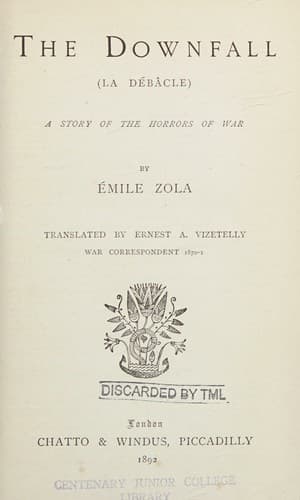
The Downfall (La Débâcle): A Story of the Horrors of WarZola, Émile
General
The Downfall (La Débâcle): A Story of the Horrors of War
Zola, Émile
Franco-Prussian War, 1870-1871 -- Fiction
It was a long business. He could be heard unlocking and re-locking
doors which, like a careful man, he kept secured. Then, at last, the
front door was just set ajar and held vigorously to prevent it from
being flung wide open. '_You_ can come in--but no one else, mind,' said
Fouchard to his son. Evident as was his repugnance, however, he could
not refuse shelter to his nephew: 'Well, you too,' he added.
Then he pitilessly pushed the door back on Jean, and Maurice again had
to supplicate. But the old man was obstinate; no, no, he didn't want
any strangers, any thieves to smash the furniture. Honoré, however,
at last forced the door open with his shoulder and made the corporal
enter; the old fellow being compelled to yield, though he continued
muttering covert threats. He had not parted with his gun, but when he
had led them into the living-room he rested it against the sideboard,
and placing the candle on the table, sank into stubborn silence.
'I say, father, we are dying of hunger. You'll surely give us some
bread and cheese?'
Fouchard made no answer; he did not seem to hear his son, but
repeatedly stepped up to the window to listen whether some fresh band
were not on the point of besieging his house. 'Come, uncle,' said
Maurice, 'Jean's a brother. He went without food to save me. We have
suffered so dreadfully together.'
The old man, however, continued his perambulations, satisfying himself
that everything was in its place, and without even casting a glance
at his son and nephew. Still without saying a word, he at last made
up his mind to grant their request, and then, taking the candle, he
went off, leaving them in the darkness and carefully locking the door
behind him so that he might not be followed. He could be heard going
down the cellar stairs, and then another long interval ensued. When he
came back he again made the door fast and placed a large loaf and a
cheese upon the table, still maintaining his obstinate silence, not,
however, that he was sullen, for his anger had passed away, but from
motives of policy, since one can never tell how far talking may lead
one. Moreover, the three men were in no mood to waste words, but fell
on the food and began to devour it. No sound could now be heard save
the savage crunching of their jaws.
Honoré at last rose to fetch a pitcher of water standing near the
sideboard. 'You might have given us some wine, father,' said he.
Fouchard, who was recovering his calmness and self-control, at the
same time found his tongue again: 'Wine? Why, I haven't a drop left.
Ducrot's men ate and drank and pillaged everything I had.'
Public-domain text, read in full here on John Shaqi.
Reviews
Reviews
No reviews yet
Be the first to share your thoughts on this work.
Elsewhere in the archive
Join the Discussion
Join the discussion
Sign in to leave a comment or review.
Sign InorCreate an account