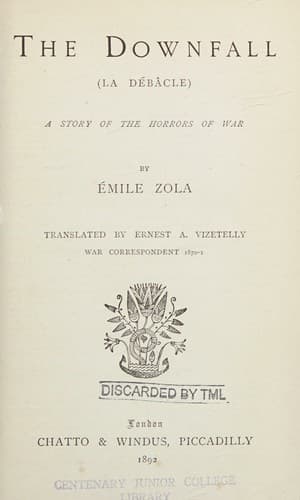
The Downfall (La Débâcle): A Story of the Horrors of WarZola, Émile
General
The Downfall (La Débâcle): A Story of the Horrors of War
Zola, Émile
Franco-Prussian War, 1870-1871 -- Fiction
Her sobs were again suffocating her, but the haunting memory of her
adventure soon brought her back to her narrative, and she related
what the woman of Beaumont had told her. This woman, who lived in the
main street of the village, had seen the German artillery pass after
nightfall. On either side of the way stood a line of soldiers carrying
torches of resin, which illumined the road with the ruddy glare of a
conflagration. And in the middle a stream of horses, guns, and caissons
swept past, urged on at a furious, hellish gallop. Frenzied and
diabolical were the haste and eagerness to achieve victory, to pursue,
overtake, finish off, and crush the French troops in the depths of some
pit near by. Nothing was spared, every obstacle was annihilated, and
still and ever the artillery swept past. If horses fell, their traces
were immediately cut, and they were crushed, rolled on, thrust aside
like bloody wreckage. The men who tried to cross were in their turn
knocked down and hashed to mincemeat by the cannon wheels. And, as
the hurricane swept along, the famished drivers did not for a moment
think of halting, but deftly caught the loaves of bread that were
flung to them, and seized hold of the hunks of meat which some of the
torchbearers had stuck upon the tips of their bayonets. And then with
these same bayonets the torchbearers prodded the horses, which reared
and plunged, and, maddened by pain, galloped faster and faster away.
And thus, as the night went by, still and ever the artillery rushed
along with tempestuous violence, in the midst of frantic hurrahs.
Despite the attention he had been giving to Silvine's narrative,
Maurice, overcome with fatigue after his gluttonous repast, had just
let his head fall upon the table, on which he was resting both arms.
For another minute Jean continued struggling, then he, in his turn, was
vanquished and fell asleep at the other end of the table. Meantime, old
Fouchard had gone down the road again, and thus Honoré found himself
alone with Silvine, who was now sitting, quite still, in front of the
open window.
The quartermaster rose up and approached the window in his turn. The
night was still dense and black, laden with the hard breathing of
thousands of troops. Louder, more sonorous sounds, were now rising,
however--now a cracking noise, then the thud of a collision. At present
some artillery was crossing the half-submerged bridge down below.
Horses reared, frightened by the dancing, flowing water. Caissons
slipped, and as they could not be righted, had to be thrown into the
stream. And at sight of the retreat which was being so painfully, so
slowly effected across the river--this retreat, which had begun the
previous day, and would certainly not be accomplished by dawn--the
young man instinctively thought of that other artillery--the artillery
of the foe--rushing like a wild torrent through Beaumont, overthrowing
all before it, and crushing both man and beast so that it might travel
the faster.
Public-domain text, read in full here on John Shaqi.
Reviews
Reviews
No reviews yet
Be the first to share your thoughts on this work.
Elsewhere in the archive
Join the Discussion
Join the discussion
Sign in to leave a comment or review.
Sign InorCreate an account