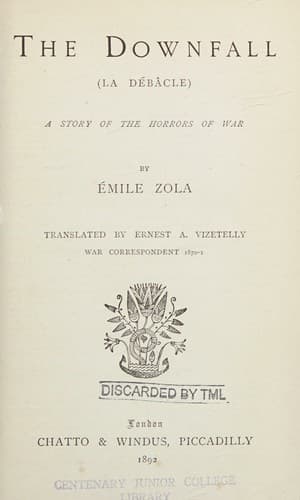
The Downfall (La Débâcle): A Story of the Horrors of WarZola, Émile
General
The Downfall (La Débâcle): A Story of the Horrors of War
Zola, Émile
Franco-Prussian War, 1870-1871 -- Fiction
Weiss lived in the Rue des Voyards, but the house, which belonged to
Delaherche, communicated in the rear with the monumental edifice in
the Rue Maqua. The Rue des Voyards was then one of the most confined
streets in Sedan, being, in fact, simply a narrow, damp lane, darkened
by the high rampart which it skirted. The eaves of the lofty frontages
almost touched one another, and the passages were as black as vaults,
especially at the end where rose the high college wall. Weiss, however,
occupying a third floor, rent and firing free, found himself quite
comfortable there, especially as he was so near his office, whither he
could betake himself in his slippers without having to appear in the
streets. He was a happy man since he had married Henriette, whom he had
long desired to make his wife at the time when he had known her at Le
Chêne, at the house of her father, the tax collector, whose housewife
she had been since she was six years old, having had to take the place
of the mother who had died in giving her birth. Weiss, meantime,
had obtained a situation at the local refinery, almost in a menial
capacity, but he had gradually educated himself, and raised himself, by
dint of hard work, to the position of accountant. Yet he only succeeded
in realising his dream through the death of Henriette's father and the
folly of her brother Maurice, whose servant she had in some measure
become, sacrificing herself in the hope of making a gentleman of him.
Brought up like a little Cinderella, knowing how to read and write,
but nothing more, she had just sold the old house and the furniture,
without, however, realising sufficient to defray the cost of Maurice's
folly, when Weiss, the worthy fellow, came forward and offered her all
he possessed, including his strong arms and his heart, and she had
consented to marry him, touched to tears by his affection and--calm,
virtuous, reasoning little woman that she was--penetrated with tender
esteem for him, in default of passionate love. And now fortune was
smiling on them, for Delaherche had talked of giving Weiss an interest
in the business, and their happiness would be complete as soon as
children were born to them.
'Take care,' said the servant to Jean; 'the stairs are very steep.'
The corporal, indeed, was stumbling up the flights in profound
darkness, but all at once a door was hastily flung open, and a ray of
light streamed over the steps. Then he heard a gentle voice exclaiming,
'It is he.'
'Madame Weiss,' called the servant, 'here's a soldier asking for you.'
A gay little laugh resounded, the laugh of one who is well pleased, and
the gentle voice replied: 'All right, I know who it is.'
Then as the corporal, stifling and ill at ease, stopped short on
the landing, the voice continued: 'Come in, Monsieur Jean. Maurice
has been here a couple of hours, and we have been waiting for you so
impatiently!'
Public-domain text, read in full here on John Shaqi.
Reviews
Reviews
No reviews yet
Be the first to share your thoughts on this work.
Elsewhere in the archive
Join the Discussion
Join the discussion
Sign in to leave a comment or review.
Sign InorCreate an account