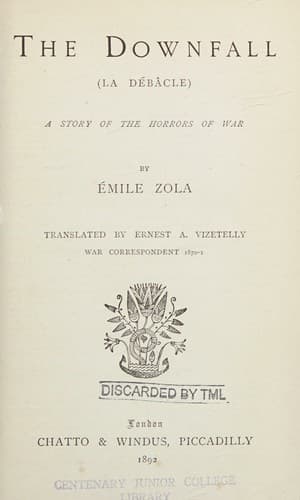
The Downfall (La Débâcle): A Story of the Horrors of WarZola, Émile
General
The Downfall (La Débâcle): A Story of the Horrors of War
Zola, Émile
Franco-Prussian War, 1870-1871 -- Fiction
Jean felt so disturbed that he could find no words to answer her, but
contented himself with returning the pressure of her small firm hand.
And again did he experience the same impression as on his arrival--this
fair-haired Henriette, so lightsome, smiling, and unobtrusive, seemed
as it were to impart a caress to the atmosphere around her.
Down below they found themselves once more in Sedan, as dank and dark
as in the morning. The twilight was already obscuring the narrow
streets, where all was bustle and confusion. Most of the shops were
closed, and the houses seemed bereft of life, but out of doors there
was a perfect crush. They reached the Place de l'Hôtel de Ville,
however, without any very great difficulty, and there they encountered
M. Delaherche, strolling about like the sightseer he was. He appeared
delighted on recognising Maurice, and at once related that he had just
been conducting Captain Beaudoin towards Floing, where the regiment
was encamped. And his accustomed satisfaction increased when he learnt
that Weiss intended to sleep at Bazeilles, for he himself had resolved
to spend the night at his dyeworks there, as, indeed, he had just been
telling the captain. 'We'll go together, Weiss,' said he. 'But meantime
let's stroll just as far as the Sub-Prefecture; perhaps we shall get a
glimpse of the Emperor.'
Napoleon III. was his one preoccupation since he had so narrowly missed
speaking to him at Baybel, and he talked in such a strain that he ended
by rousing the curiosity of the two soldiers, who decided to follow
him. Only a few whispering groups were assembled on the Place de la
Sous-Préfecture, but from time to time some scared officers dashed by.
The mournful dimness was already darkening the trees, and one could
hear the loud noise made by the Meuse as it flowed along at the foot
of the houses on the right hand. Some of the assembled people were
relating that the Emperor--who had only been induced with difficulty
to leave Carignan at eleven o'clock the previous night--had positively
refused to push on to Mézières, as he wished to remain on the scene of
danger, so as not to demoralise the troops. Others asserted, however,
that he was no longer at Sedan, that he had fled, leaving one of his
lieutenants behind to personate him--an officer who had donned his
uniform, and who was so remarkably like him that the entire army was
deceived. Others, again, gave their word of honour that they had seen
several vehicles, containing the imperial treasure (a hundred millions
of francs in brand-new gold napoleons), drive into the grounds of
the Sub-Prefecture. But the vehicles in question were simply those
of the Emperor's household, the char-à-bancs, the two calashes,
and the twelve vans, the sight of which had so revolutionised the
villages, Courcelles, Le Chêne and Raucourt, and the number of which
rumour had so exaggerated that in the popular imagination they had
become an immense train, obstructing the roads to such a degree that
Public-domain text, read in full here on John Shaqi.
Reviews
Reviews
No reviews yet
Be the first to share your thoughts on this work.
Elsewhere in the archive
Join the Discussion
Join the discussion
Sign in to leave a comment or review.
Sign InorCreate an account