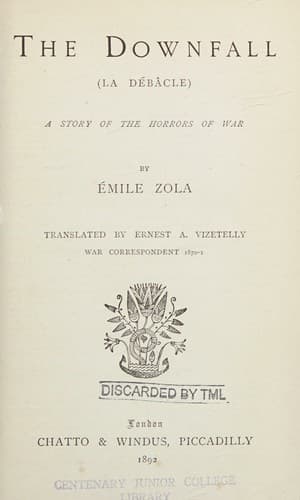
The Downfall (La Débâcle): A Story of the Horrors of WarZola, Émile
General
The Downfall (La Débâcle): A Story of the Horrors of War
Zola, Émile
Franco-Prussian War, 1870-1871 -- Fiction
Delaherche's curiosity was so acute and restless that it had almost
lent him some courage. He had not closed his eyes during the night,
being greatly interested in the defensive preparations that were being
made by the French troops. Foreseeing that he would be attacked at
daybreak, General Lebrun, who commanded the Twelfth Army Corps, had
employed the night in entrenching himself in Bazeilles. Orders had been
given him that he must at any cost prevent the enemy from occupying
the village, and accordingly barricades had been thrown up across the
high road and the side streets, each house had been garrisoned, and
each lane and garden transformed into a fortress. And the men, quietly
roused in the inky darkness, were already at their posts at three in
the morning, each with ninety cartridges in his pouch and with his
chassepot freshly lubricated. Thus it happened that the enemy's first
cannon shot surprised nobody; and the French batteries, posted in the
rear between Balan and Bazeilles, immediately answered it, more by way
of announcing their presence, however, than for any serious purpose,
for the firing was mere guess work and could hardly prove effective in
such a fog.
'The dyeworks will be vigorously defended,' resumed Delaherche. 'I've
got an entire section there. Come and see.'
Forty and odd men of the Marine Infantry had indeed been posted there,
under the command of a lieutenant, a tall, fair fellow, very young,
but with an energetic, stubborn expression of countenance. His men
had already taken possession of the building, and whilst some of them
loopholed the shutters on the first floor, others embattled the low
wall of the courtyard overlooking the meadows in the rear. It was in
the courtyard that Delaherche and Weiss found the lieutenant, who was
vainly trying to distinguish the enemy's positions through the morning
mist.
'What a horrid fog!' he muttered. 'We can't fight groping.' And
immediately afterwards, without the slightest transition, he inquired:
'What day is it?'
'Thursday,' replied Weiss.
'Thursday--oh, yes! The devil take me, but we live as though the world
no longer existed.'
At that moment, amid the thundering of the guns, which did not for a
moment cease, a lively fusillade burst forth on the outskirts of the
meadows, some two or three hundred yards away. And just then there was
a sudden change in the surroundings, similar to a transformation scene
at a theatre--the sun arose, the vapour from the Meuse flew away in
fragments like shreds of delicate muslin, and a blue sky of spotless
limpidity appeared to view. A delightful morning was heralding in a
glorious summer day.
'Ah!' exclaimed Delaherche, 'they are crossing the railway bridge--do
you see them trying to gain ground along the line? What crass stupidity
on our part--the bridge ought to have been blown up!'
Public-domain text, read in full here on John Shaqi.
Reviews
Reviews
No reviews yet
Be the first to share your thoughts on this work.
Elsewhere in the archive
Join the Discussion
Join the discussion
Sign in to leave a comment or review.
Sign InorCreate an account