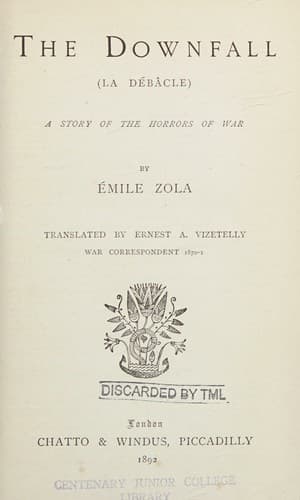
The Downfall (La Débâcle): A Story of the Horrors of WarZola, Émile
General
The Downfall (La Débâcle): A Story of the Horrors of War
Zola, Émile
Franco-Prussian War, 1870-1871 -- Fiction
Weiss shook his head, however, scanned the horizon around him, and
then, in a hesitating way, as though he were talking to himself,
remarked: 'Well, no--no--I hardly fancy that--I'm afraid of something
else--something I hardly dare say----' He spoke no further, but held
out his arms as though they were the branches of a vice; and then
turning towards the north, he brought his hands together as if the
vice-chops had suddenly met. In this fashion he expressed the fears
that had been troubling him since the previous day, fears based on his
knowledge of the country, and on everything that he had observed of
the march of the hostile armies. And even now, when the broad plain
expanded in the radiant sunshine, his eyes returned once more to the
hills on the left bank of the river, over which, throughout an entire
day and an entire night, there had marched such an interminable, black
swarm of German troops. A battery was firing from the left of Remilly,
but the one whose shells were beginning to fall at Bazeilles was
installed at Pont-Maugis on the bank of the river. Weiss folded his
eye-glasses one over the other, and held them to one eye that he might
the more effectually explore the wooded slopes. However, he could only
see the white puffs of smoke with which the guns were, each minute,
capping the heights. What had become, then, of the human torrent which
had streamed along those hills? All that he could distinguish, after
prolonged scrutiny, was a cluster of horses and uniforms--some general
and his staff, no doubt--perched at the corner of a pine wood on the
Marfée hill, above Noyers and Frénois. Farther on was the loop of
the Meuse, barring the west; and on this side the only possible line
of retreat on Mézières lay along the narrow road passing through the
defile of St. Albert, between the river and the forest of the Ardennes.
On the previous day, chancing to meet a general in a hollow road of
the valley of Givonne--a general who he afterwards learnt was Ducrot,
the commander of the First Corps--Weiss had ventured to speak to him
of this one possible line of retreat. Unless the troops immediately
retired by the road in question, if they waited until the Prussians had
crossed the Meuse at Donchery and intercepted the passage of the river,
they would certainly find themselves immobilised, brought to a stand
at the Belgian frontier. That same evening, moreover, it had already
seemed too late to effect the movement, for the Uhlans were reported
to be in possession of the Donchery bridge--another bridge which had
not been blown up, in this case through forgetfulness to bring the
powder required for the purpose. And now, thought Weiss despairingly,
the whole stream of men, the great black swarm, must be crossing the
plain of Donchery on its way towards the defile of St. Albert, with
its advance guard already threatening St. Menges and Floing, whither
he had conducted Jean and Maurice the previous night. He could espy
Public-domain text, read in full here on John Shaqi.
Reviews
Reviews
No reviews yet
Be the first to share your thoughts on this work.
Elsewhere in the archive
Join the Discussion
Join the discussion
Sign in to leave a comment or review.
Sign InorCreate an account