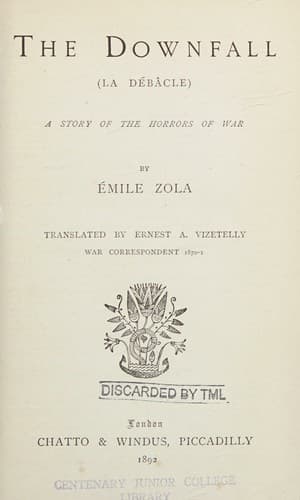
The Downfall (La Débâcle): A Story of the Horrors of WarZola, Émile
General
The Downfall (La Débâcle): A Story of the Horrors of War
Zola, Émile
Franco-Prussian War, 1870-1871 -- Fiction
The night was very dark, and down below she could scarcely distinguish
the pavement of the Rue des Voyards, a narrow, gloomy passage hemmed
in by old houses. The only light was a smoky, star-like lamp some
distance away, in the direction of the college. And from the depths
beneath there ascended a cellar-like, saltpetrous smell, the occasional
caterwauling of some angry tom, the heavy footfall of some soldier who
had lost his way. Moreover, unaccustomed noises resounded through Sedan
behind her, sudden gallops, continuous rumblings, which sped along like
threats of death. She listened, with her heart beating loudly, but
still and ever she failed to recognise the steps of her husband coming
round the corner.
Hours went by, and she became anxious concerning the distant glimmers
which she could espy along the country side, beyond the ramparts.
It was so dark that she had to picture the situation of the various
localities. That huge pale sheet down below was evidently the water
covering the flooded meadows. But what was that fire which she had
seen flare up and then die away, over yonder, doubtless on the Marfée
hill? And there were other fires flaming all along the hills, at
Pont-Maugis, Noyers, and Frénois, mysterious fires vacillating above
an innumerable multitude, swarming there in the darkness. But it was
especially the extraordinary sounds which she heard that made her
start and tremble--the tramping of a people on the march, the panting
of horses, the clang of arms, quite a chevachie passing along afar
off, in the depths of that dim inferno. Suddenly the booming of
a cannon resounded, one formidable, frightful report, followed by
perfect silence. It froze all the blood in her veins. What could it
be? A signal, no doubt--a signal that some movement had succeeded, an
announcement that they were ready over yonder, and that the sun might
now rise when he pleased.
At about two in the morning Henriette, still dressed, threw herself
upon her bed, neglecting even to close the window. She was quite
overcome with fatigue and anxiety. What could be the matter with her,
that she should now be shivering with fever like that--she, as a rule,
so calm, with so light a step that one heard her no more than if she
had not existed? She slept painfully, numbed as it were, but with a
persistent consciousness of the catastrophe that weighed so heavily
in the black atmosphere. All at once, in the midst of her uneasy
slumber, the voice of the cannon was heard again; dull, distant reports
resounded; and now the firing went on regularly, stubbornly, without
cessation. She sat up on her bed shuddering. Where was she? She no
longer recognised, no longer even saw the room, which seemed to be full
of dense smoke. Then all at once she understood that the mist rising
from the neighbouring river must have entered through the open window.
Outside, the guns were now sounding more frequently. She sprang off the
bed and hastened to the window to listen.
Public-domain text, read in full here on John Shaqi.
Reviews
Reviews
No reviews yet
Be the first to share your thoughts on this work.
Elsewhere in the archive
Join the Discussion
Join the discussion
Sign in to leave a comment or review.
Sign InorCreate an account