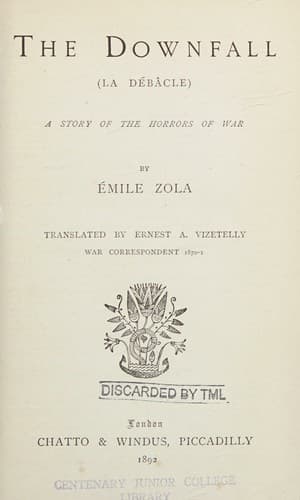
The Downfall (La Débâcle): A Story of the Horrors of WarZola, Émile
General
The Downfall (La Débâcle): A Story of the Horrors of War
Zola, Émile
Franco-Prussian War, 1870-1871 -- Fiction
And then he began strolling through Sedan, like an inquisitive
_bourgeois_ bent on missing none of the sights, though to tell the
truth he was now labouring under increasing disquietude. What would
be the end of it all? Would not the town suffer a great deal if the
army were beaten? Such were the questions he put to himself; but the
answers remained obscure, being almost wholly dependent on the course
that events might take. Nevertheless, he began to feel very anxious
about his factory, his house property in the Rue Maqua, whence, by the
way, he had been careful to remove all his securities, burying them in
a safe place. At last he repaired to the town-hall, where, finding the
municipal council assembled _en permanence_, he lingered a long while,
without, however, learning anything fresh, except that the battle was
progressing unfavourably. The army no longer knew whom to obey--drawn
back as it had been by General Ducrot during the two hours when he
had exercised the chief command, and suddenly thrown forward again by
General de Wimpffen, who had succeeded him; and these incomprehensible
veerings, these positions which had to be reconquered after being
abandoned, the utter absence of any plan, any energetic direction, all
combined to precipitate the disaster.
Delaherche next went as far as the Sub-Prefecture to ascertain whether
the Emperor had returned. But here they could only give him news of
Marshal MacMahon, who, having had his wound, which was of but little
gravity, dressed by a surgeon, was now lying quietly in bed. At about
eleven o'clock, however, whilst Delaherche was again roaming the
streets, he was stopped for a moment in the Grande Rue, just in front
of the Hôtel de l'Europe, by a cortège of dusty horsemen, who were
slowly walking their dejected steeds. And at the head of the party he
recognised the Emperor, who was now returning to his quarters after
spending four hours on the battlefield. Decidedly, death had not
been willing to take him. The perspiration caused by the anguish of
that long ride through the defeat, had made the paint trickle from
his cheeks, and softened the wax of his moustaches, which were now
drooping low, whilst his cadaverous countenance expressed the painful
stupor of mortal agony. An officer, who alighted at the hotel, began
to explain to a cluster of townsfolk that they had ridden all along
the little valley from La Moncelle to Givonne, among the troops of
the First Corps, whom the Saxons had thrown back on to the right bank
of the stream; and they had returned by way of the hollow road of the
Fond-de-Givonne, which was already so obstructed that had the Emperor
desired to proceed once more to the front, he could only have done so
with very great difficulty. Besides, what would have been the good of
it?
Public-domain text, read in full here on John Shaqi.
Reviews
Reviews
No reviews yet
Be the first to share your thoughts on this work.
Elsewhere in the archive
Join the Discussion
Join the discussion
Sign in to leave a comment or review.
Sign InorCreate an account