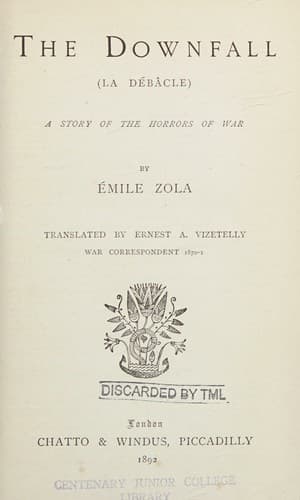
The Downfall (La Débâcle): A Story of the Horrors of WarZola, Émile
General
The Downfall (La Débâcle): A Story of the Horrors of War
Zola, Émile
Franco-Prussian War, 1870-1871 -- Fiction
In this way he jested with Jean, both of them quite inspirited by the
smart, calm bravery of the artillerymen. In three shots, however, the
Prussian batteries had regulated their fire; their range had at first
been too long, but their practice now became so wonderfully accurate
that their shells fell upon the French guns, which, despite every
effort to increase their range, still failed to carry the distance. One
of Honoré's men, on the left, was killed. The corpse was pushed aside,
and the firing continued, still with the same careful regularity,
and without the slightest display of haste. Projectiles were coming
from, and exploding on all sides, whilst around each piece the same
methodical manœuvres were repeated, the gun was loaded with its charge
and shell, the sighting was regulated, the shot was fired, and the
piece, having recoiled, was run up again as though the work absorbed
these men to such a degree that they could neither see nor hear
anything else.
Maurice, however, was especially struck by the demeanour of the
drivers, who, stiffly erect on their horses, confronted the enemy,
fifteen yards or so in the rear of the guns. Adolphe was among them
with his broad shoulders, bushy fair moustaches, and rubicund face;
and a man needed to be brave, indeed, to stay there like that, without
so much as blinking his eyes, whilst he watched the shells coming
straight towards him, and without being able even to bite his nails by
way of occupation, and in order to divert his thoughts. The gunners
on their side were working; they had so much to attend to that they
could not think of danger, whereas the motionless drivers saw but death
before their eyes, and had full leisure to ponder upon it and await
its coming. They were compelled to face the enemy, because, had they
turned their backs upon him, an irresistible impulse to flee might have
carried both men and horses away. A man can brave danger when he sees
it. There is no more obscure and yet no greater heroism than this.
Another gunner had just had his head carried off; two horses, harnessed
to a caisson, had fallen with their bellies ripped open; and the fire
of the foe was proving so slaughterous that it was evident the entire
battery would be dismounted, if they obstinately remained on this same
spot. Despite all the inconvenience of a change of position, it was
necessary to foil the enemy's terrible fire, and the captain no longer
hesitated, but ordered up the fore-carriages.
Public-domain text, read in full here on John Shaqi.
Reviews
Reviews
No reviews yet
Be the first to share your thoughts on this work.
Elsewhere in the archive
Join the Discussion
Join the discussion
Sign in to leave a comment or review.
Sign InorCreate an account