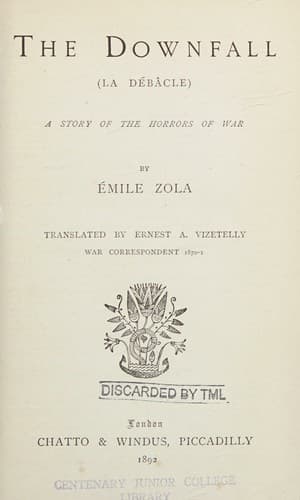
The Downfall (La Débâcle): A Story of the Horrors of WarZola, Émile
General
The Downfall (La Débâcle): A Story of the Horrors of War
Zola, Émile
Franco-Prussian War, 1870-1871 -- Fiction
In front of the town-hall Delaherche was hustled by a stream of haggard
soldiers coming from the Faubourg of La Cassine. He lost sight of the
colonel, and thereupon renounced his intention of going to see the
hoisting of the white flag. He would certainly not be allowed to enter
the keep; and besides, on hearing some people say that shells were
falling on the college, he was once more filled with anxiety. Perhaps
his factory had caught fire during his absence. Thereupon he darted
off again, possessed by a feverish desire to be on the move, which he
endeavoured to satisfy by running through the streets. Groups of people
barred his way, however; at each crossing there were fresh obstacles.
It was only on reaching the Rue Maqua that he gave a sigh of relief,
on finding that the monumental front of his house was intact, that
neither a puff of smoke nor a spark of fire was to be seen. He went in
and called out to his mother and his wife: 'Things are going all right;
they are hoisting the white flag, so the firing will soon be over.'
Then he stopped short, for the scene which the ambulance presented
was really terrible. Not only was every mattress occupied in the
spacious drying-room, the door of which was open, but there no longer
remained any space even on the litter of straw spread out at one end
of the building. More straw was now being laid between the beds: the
wounded were being closely packed, one beside the other. There were
already more than a couple of hundred of them, and others were still
arriving. A white light streamed from the broad windows upon all this
accumulation of human suffering. At times there arose some involuntary
cry occasioned by too sudden a movement; and now and again the rattle
of the death pangs was wafted through the moist atmosphere. From one
end of the room there long resounded a continuous, gentle, almost
musical wail. Then the silence became deeper, like a kind of resigned
stupor, like the oppressive mournfulness of a death room, broken only
by the steps and whispers of the attendants. The wounds, most of which
had been hastily dressed on the battlefield, though some had remained
bare, untended, were displayed in all their distressful horror, amid
shreds of torn capotes and trousers. Feet were stretched out, still
booted, but crushed and bleeding. Inert limbs dangled from knees and
elbows which had been smashed as though by blows of a hammer. There
were broken hands and hanging fingers, too, sustained by mere strips
of skin. Most numerous, apparently, were the fractured legs and arms,
stiffened by pain and as heavy as lead; but the disquieting wounds
were especially those that had opened up the stomach, the chest, or
the head. Blood was flowing from flanks that had been frightfully
lacerated; bowels had become knotted under upraised skin; some men,
through their loins being gashed and hacked, were twisted into
frightfully distorted postures. Some lungs had been perforated through
Public-domain text, read in full here on John Shaqi.
Reviews
Reviews
No reviews yet
Be the first to share your thoughts on this work.
Elsewhere in the archive
Join the Discussion
Join the discussion
Sign in to leave a comment or review.
Sign InorCreate an account