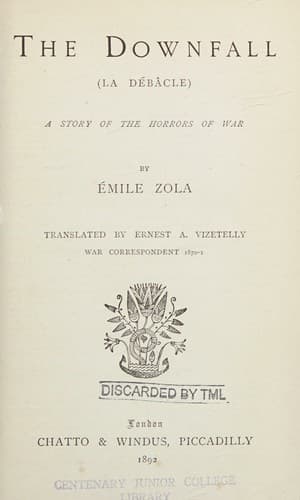
The Downfall (La Débâcle): A Story of the Horrors of WarZola, Émile
General
The Downfall (La Débâcle): A Story of the Horrors of War
Zola, Émile
Franco-Prussian War, 1870-1871 -- Fiction
The others roared, thinking this very droll, though they could not say
why. However, the slightest incidents of the journey--the sight of some
peasants posted beside the line, of the groups of anxious people who,
in the hope of obtaining news, were waiting at the smaller stations
for the trains to pass, the view, too, of all that region of France
scared and quivering in presence of the invasion--sufficed to provoke
hooting, shouting, and deafening laughter. And in the gust of wind that
swept by as the engine forged onward, amid the rapid view they obtained
of the train enveloped in smoke and noise, those that had hastened to
the stations received full in the face the howls of these men, all
food for powder, who were being carried along at express speed. At
one station, however, where they stopped, three well-dressed ladies,
rich _bourgeoises_ of the town, who distributed bowls of broth to the
soldiers, met with great success. The men cried as they thanked them,
and kissed their hands.
But farther on, the filthy songs and the savage yells burst forth
again. Shortly after passing Chaumont the train met another one full
of some artillerymen who were no doubt being taken to Metz. Speed had
just been slackened, and the soldiers of the two trains fraternised
amid a fearful clamour. It was, however, the artillerymen, doubtless
more intoxicated than the others, who carried off the palm by shaking
their fists out of the trucks and raising this cry with such despairing
violence that it drowned everything else: 'To the slaughter! slaughter!
slaughter!'
It seemed as if a great chill, an icy wind from a charnel-house were
passing by. There was a sudden brief silence, amid which one heard
Loubet jeering: 'The comrades are not gay.'
'But they are in the right,' rejoined Chouteau, in his tavern-orator's
voice; 'it's disgusting to send a lot of brave chaps to get their
heads cracked on account of some dirty business they don't know a word
about.' And he continued talking in the same strain. This incapable
workman of Montmartre, this lounging, dissipated house-painter, who
had badly digested some scraps of speeches heard at public meetings,
and who mingled revolutionary clap-trap with the great principles
of equality and liberty, played the part of the perverter. He knew
everything, and indoctrinated his comrades, especially Lapoulle,
whom he had promised to make a man of: 'Eh, old fellow? It's simple
enough. If Badinguet and Bismarck have a row together let them settle
it between them with their fists, instead of troubling hundreds of
thousands of men who don't even know one another, and have no wish to
fight.'
The whole truck-load laughed, feeling amused and subjugated, and
Lapoulle, who did not even know who Badinguet[11] was, and who could
not even have said whether he was fighting for an Emperor or a King,
repeated, with that overgrown-baby air of his: 'Of course, with their
fists--and a glass of wine together afterwards.'
Public-domain text, read in full here on John Shaqi.
Reviews
Reviews
No reviews yet
Be the first to share your thoughts on this work.
Elsewhere in the archive
Join the Discussion
Join the discussion
Sign in to leave a comment or review.
Sign InorCreate an account