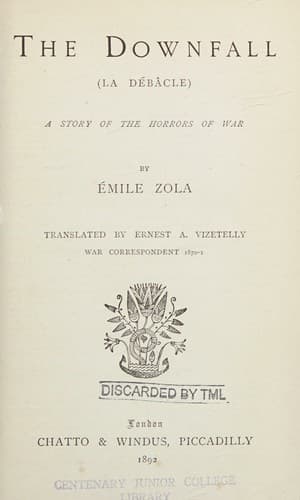
The Downfall (La Débâcle): A Story of the Horrors of WarZola, Émile
General
The Downfall (La Débâcle): A Story of the Horrors of War
Zola, Émile
Franco-Prussian War, 1870-1871 -- Fiction
His legs sinking from fatigue, Maurice seated himself at last on a
bench. The town around him seemed to be living its daily life. Nurses
were minding children under the beautiful trees, and petty cits were
slowly taking their usual walk. Maurice scanned his papers again, and
in doing so came upon an article he had not previously noticed in one
of the most fiery of the Republican opposition journals. This threw
a vivid light on the situation. At the council held at the camp of
Châlons on August 17, so this newspaper asserted, the retreat of the
army upon Paris had been decided on, and General Trochu's appointment
as governor of the capital had been made solely with the view of
preparing the Emperor's return. But the newspaper added that these
decisions had been frustrated by the attitude which the Empress-Regent
and the new ministry[13] had taken up. According to the Empress Eugénie
a revolution was certain if the Emperor returned to Paris. 'He would
not reach the Tuileries alive,' she was asserted to have said. And
she obstinately insisted on a forward march, on MacMahon effecting
a junction, despite every obstacle, with the army of Metz; in which
views she was supported by the minister of war, General de Palikao, who
had planned a victorious, lightning march for MacMahon, so that the
latter might join hands with Bazaine. Gazing dreamily in front of him,
with his paper lying on his knees, Maurice now fancied that he could
understand everything: The two conflicting plans; MacMahon's hesitation
to undertake this dangerous flank march with such indifferent troops;
and the impatient, increasingly fretful orders which reached him from
Paris, urging him into this madly rash adventure. Whilst picturing the
tragical struggle, Maurice had a clear vision of the Emperor, deprived
of his imperial authority which he had confided to the Empress-Regent,
and divested of the supreme command of the army which he had entrusted
to Marshal Bazaine, so that he had now become a mere nothing--a vague,
undefined shadow of an Emperor, a nameless and cumbersome inutility,
whom no one knew what to do with, whom Paris rejected, and who no
longer had any place in the army since he had undertaken not to give it
a single order.
Public-domain text, read in full here on John Shaqi.
Reviews
Reviews
No reviews yet
Be the first to share your thoughts on this work.
Elsewhere in the archive
Join the Discussion
Join the discussion
Sign in to leave a comment or review.
Sign InorCreate an account