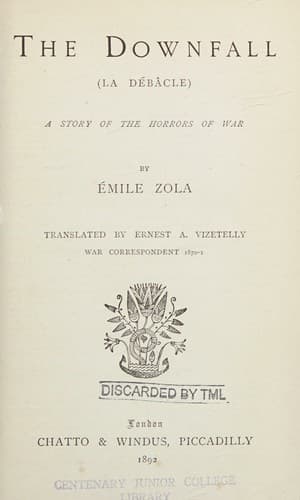
The Downfall (La Débâcle): A Story of the Horrors of WarZola, Émile
General
The Downfall (La Débâcle): A Story of the Horrors of War
Zola, Émile
Franco-Prussian War, 1870-1871 -- Fiction
These tales did not seem to belong to history; different periods
were blended, and all the nations of the earth met together in one
great, fearful collision. The English, the Austrians, the Prussians,
the Russians passed by--now in turn, now all at the same time--just
as alliances willed it, and without it being possible to say why some
were beaten rather than others. But beaten they were, inevitably
beaten in advance by a great dash of heroism and genius which swept
armies away as if they had been merely chaff. There was Marengo, the
classical engagement on level ground, with the long lines of troops
skilfully deployed, and the faultless retreat in échelon order of the
battalions so silent and impassive under fire. This was the legendary
battle lost at three o'clock, won at six; the battle when eight hundred
grenadiers of the Consular Guard arrested the onslaught of the entire
Austrian cavalry; when Desaix came up to meet his death and to change
an impending rout into an immortal victory. Then there was Austerlitz,
with its beautiful sun of glory shining through the wintry mist;
Austerlitz, commencing with the capture of the plateau of Pritzen and
ending with the terrifying disruption of the ice on the frozen lakes,
when an entire Russian army corps, men and horses, sank into the water
amid a frightful crash; whilst the god-like Napoleon, who had naturally
foreseen everything, completed the disaster with his round shot. Next
there was Jena, where Prussia's power was entombed; at first, the
skirmishers firing through the October fog, and Ney, by his impatience,
almost compromising everything; then Augereau's advance that extricated
Ney, the great onslaught, so violent that it swept away the enemy's
entire centre; and finally the panic, the _sauve-qui-peut_ of an
over-vaunted cavalry, whom the French Hussars mowed down like ripe
oats, strewing the romantic valley with men and horses. Then there was
Eylau--Eylau, the abominable--the most bloody of battles, when such was
the slaughter that the hideously disfigured bodies lay on the ground
in heaps; Eylau, blood red under its snow storm, with its mournful
cemetery of heroes; Eylau still loudly re-echoing the thunderous charge
of Murat's eighty squadrons, which cut right through the Russian army
and strewed the field with such a depth of corpses that even Napoleon
himself wept at the sight.
Public-domain text, read in full here on John Shaqi.
Reviews
Reviews
No reviews yet
Be the first to share your thoughts on this work.
Elsewhere in the archive
Join the Discussion
Join the discussion
Sign in to leave a comment or review.
Sign InorCreate an account