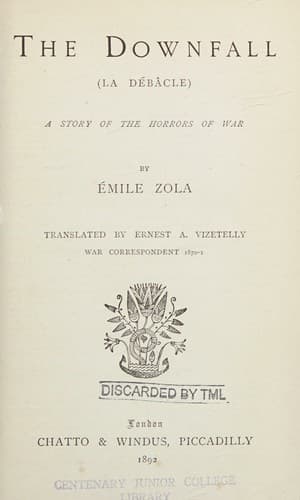
The Downfall (La Débâcle): A Story of the Horrors of WarZola, Émile
General
The Downfall (La Débâcle): A Story of the Horrors of War
Zola, Émile
Franco-Prussian War, 1870-1871 -- Fiction
To reach the road from Rheims to Vouziers the 106th almost immediately
began cutting along by-ways and ascending slopes of stubble. This
lasted during more than an hour. Lower down, towards the north,
Béthiniville, where the Emperor was said to have slept, could be seen
embowered in trees. Then, on reaching the Vouziers road, they again
found themselves among plains similar to those of the day before. The
last sorry fields of 'la Champagne pouilleuse' were here spread out in
all their dispiriting monotony. A meagre stream, the Arne, now flowed
on the left, whilst the vast expanse of barren land stretched away on
the right, so flat that the distance of the horizon was considerably
increased. The soldiers passed through some villages, St. Clément,
with its only street winding along the road, and St. Pierre, a large
place inhabited by well-to-do folks, who had barricaded their doors and
windows. The men halted at about ten o'clock near another village, St.
Etienne, where, to their great delight, they were able to procure some
tobacco. The Seventh Corps had now become divided into several columns,
and the 106th marched on with merely a battalion of foot Chasseurs and
the reserve artillery behind it. Vainly did Maurice turn round at the
bends of the road, in the hope of seeing the immense convoy which had
so greatly interested him the day before; the herds were no longer
there, and he could only espy the cannon which--as they rolled over
this low level plain--looked larger than they really were, seeming not
unlike dark grasshoppers with unusually long legs.
After passing St. Etienne, however, the road became frightful; it
ascended by gentle winding slopes through large barren fields dotted
with little woods of pine trees, ever the same, and which, with
their foliage of a blackish green, looked infinitely mournful amid
the expanse of white soil. The troops had not passed through such
a desolate scene before. Badly metalled, moreover, and softened by
the last rains, the road was a perfect bed of mud, of liquefied grey
argil, to which the feet adhered as to pitch. The fatigue of marching
consequently became extreme, and the exhausted men no longer made way.
As a crowning worry, violent showers suddenly began to fall. But little
more was needed, and the artillery, which had stuck in the mire, would
have remained there.
Out of breath, and infuriated with his crushing burden, Chouteau, who
was carrying some rice distributed to the squad, flung it away at a
moment when he thought himself unobserved. But Loubet had seen him, and
remarked: 'That's a dirty trick to play, for it means short commons for
everyone.'
'Humbug!' replied Chouteau; 'there's plenty of everything, so we can
get some more when we halt.'
Influenced by this specious reasoning, Loubet, who was carrying the
bacon, rid himself of his burden in his turn.
Public-domain text, read in full here on John Shaqi.
Reviews
Reviews
No reviews yet
Be the first to share your thoughts on this work.
Elsewhere in the archive
Join the Discussion
Join the discussion
Sign in to leave a comment or review.
Sign InorCreate an account