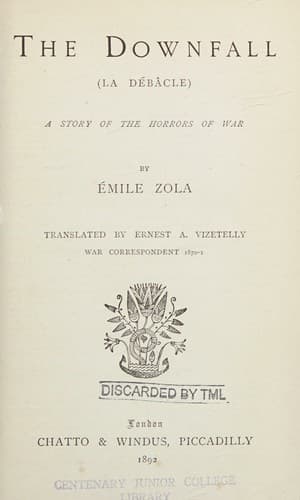
The Downfall (La Débâcle): A Story of the Horrors of WarZola, Émile
General
The Downfall (La Débâcle): A Story of the Horrors of War
Zola, Émile
Franco-Prussian War, 1870-1871 -- Fiction
Maurice no longer doubted it. He had fully recognised the man who
had been set at liberty at the camp of Mulhausen for lack of proof
against him, and this man was Goliath, whom old Fouchard of Remilly
had formerly employed. When the farmer, however, was at last prevailed
upon to open his door, they searched the farm in vain, the so-called
Alsatian had disappeared. That good-natured looking, fair-haired
colossus, whom General Bourgain-Desfeuilles had questioned to no
purpose whilst dining the day before, and in whose presence he had
carelessly confessed his own ignorance and bewilderment, had gone off!
The rascal had no doubt jumped out by a back window, which was found
open, but it was in vain that they scoured the surrounding fields; huge
though he was, the fellow had vanished like smoke.
Maurice was obliged to lead Honoré away, for in his despair the
quartermaster was on the point of telling his comrades more than was
advisable of certain sad family affairs which they had no need to know.
'Thunder! I should have so liked to strangle him!' said Honoré; 'I was
the more enraged against him on account of the letter I've received.'
Then, as they had both seated themselves against a rick at a few steps
from the farmhouse, he handed the letter in question to Maurice.
That love affair between Honoré Fouchard and Silvine Morange was but
the old, old story. She, a dark-complexioned girl, with beautiful
submissive eyes, had, when very young, lost her mother, a workwoman
employed at a factory at Raucourt. She was a natural child, and Dr.
Dalichamp, her godfather, a worthy man who was always ready to adopt
the offspring of the poor creatures he attended, had found her a
situation as servant girl with Fouchard, the father. The old peasant,
who in his eagerness for gain had turned butcher, hawking his meat
through a score of surrounding villages, was certainly frightfully
avaricious, and a pitiless hard master as well; but the doctor reasoned
that he would watch over the girl, and that she, providing she worked
well, would at all events not lack her daily bread. In any case, she
would escape the loose life of the factory. Then it naturally came
to pass that young Fouchard and the little servant girl fell in love
with one another. Honoré was sixteen when she was twelve, and when
she was sixteen he was twenty. Then, when he drew his number at the
conscription, he was delighted to find it a good one, and determined to
marry her. There had never been any impropriety between them; Honoré
was, indeed, of a calm, thoughtful disposition, and at the most they
had kissed each other in the barn. However, when Honoré broached the
subject of the marriage to his father, the latter was exasperated, and
stubbornly declared that it should not take place whilst he was living.
Still, he kept the girl in his service, thinking, perhaps, that the
young fellow's fancy would pass off; hoping, too, possibly, for things
that did not happen.
Public-domain text, read in full here on John Shaqi.
Reviews
Reviews
No reviews yet
Be the first to share your thoughts on this work.
Elsewhere in the archive
Join the Discussion
Join the discussion
Sign in to leave a comment or review.
Sign InorCreate an account