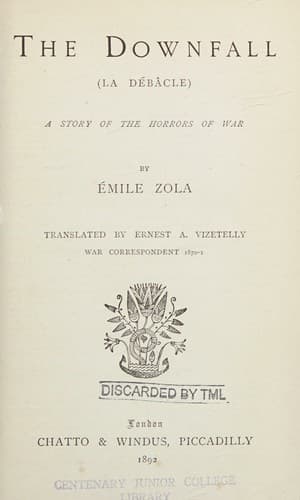
The Downfall (La Débâcle): A Story of the Horrors of WarZola, Émile
General
The Downfall (La Débâcle): A Story of the Horrors of War
Zola, Émile
Franco-Prussian War, 1870-1871 -- Fiction
The discouragement which possessed Maurice, and which he analysed like
an intelligent, well-educated man, was increasing and weighing more and
more heavily upon all the troops who were immobilised there, consumed
with waiting and expectation. Doubt and a presentiment of the truth
were dimly penetrating their sluggish brains; and there was not a man
among them, however limited his mental powers, who did not experience
an uneasy consciousness that he was badly commanded, and ought not to
have been where he was; though on the other hand he could not exactly
tell why it was that he felt so exasperated. What were they doing
there, good heavens! since the Prussians did not appear? Let them
either fight at once or go off somewhere where they could sleep in
peace. They had had quite enough of it. The anxiety went on increasing
every minute after the departure of the last aide-de-camp despatched
to Le Chêne for orders, and the men gathered together in groups and
discussed matters openly. Their agitation even gained the officers, who
did not know what to reply to those who were bold enough to question
them. And thus it came to pass that every breast was lightened as of a
grievous burden, and gave vent to a sigh of profound delight when, at
five o'clock, a report spread that the aide-de-camp had returned, and
that they were now about to fall back!
So prudence had at last gained the upper hand! The Emperor and
MacMahon, who had never been in favour of that advance on Montmédy,
and who felt uneasy at the news that they had again been outmarched
by the foe, and were about to find both the army of the Crown Prince
of Prussia and that of the Crown Prince of Saxony confronting them,
renounced all idea of that improbable junction with Bazaine, and
decided upon retreating by way of the northern strongholds, in such
a manner as to fall back eventually upon Paris. The Seventh Corps
received orders to proceed to Chagny by way of Le Chêne Populeux,
whilst the Fifth was to march on Poix, and the Fifth and Twelfth on
Vendresse. But if they were to fall back, why had they thus advanced to
the Aisne--why had so many days been lost--why had they been subjected
to so much fatigue, when it would have been so easy and so logical
for them, at the time they were at Rheims, to have taken up strong
positions forthwith in the valley of the Marne? Had their commanders no
managing capacity, no military talent, no common-sense even? However,
the men no longer took the trouble to question one another; they
forgave the past in their delight at the sensible decision which had
at last been arrived at--the only method by which they might extricate
themselves from the wasp's nest into which they had ventured. From the
generals down to the rank and file, one and all felt that they could
again recover strength--nay, prove invincible--under Paris, and that it
was there that they would beat the Prussians. But it was necessary to
Public-domain text, read in full here on John Shaqi.
Reviews
Reviews
No reviews yet
Be the first to share your thoughts on this work.
Elsewhere in the archive
Join the Discussion
Join the discussion
Sign in to leave a comment or review.
Sign InorCreate an account