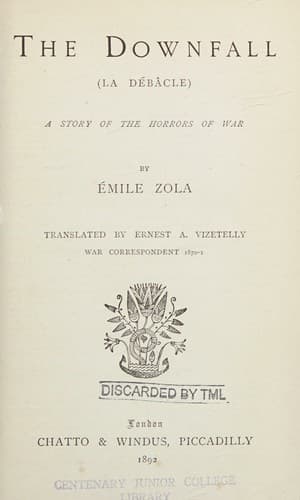
The Downfall (La Débâcle): A Story of the Horrors of WarZola, Émile
General
The Downfall (La Débâcle): A Story of the Horrors of War
Zola, Émile
Franco-Prussian War, 1870-1871 -- Fiction
Once on the road, the petty farmer who was driving Maurice did not
cease to bewail the evil times. He had lacked the necessary courage
to remain at Falaise, and yet he already regretted having left it,
repeating that he would be utterly ruined if the enemy should burn
his house. His daughter--a tall, pale creature--was crying. Maurice,
however--drunk, as it were, with weariness--did not hear either of
them, but slept on in a sitting posture, rocked by the rapid trot
of the little horse, which in less than an hour and a half covered
the four leagues lying between Vouziers and Le Chêne. It was not yet
seven o'clock, and the twilight had scarcely fallen, when the young
fellow, shivering and perplexed, alighted on the Place, near the bridge
spanning the canal, and in front of the narrow yellow house where he
had been born and had spent the first twenty years of his life. He was
going there in a mechanical sort of way, oblivious of the fact that
the house had been sold to a veterinary surgeon some eighteen months
previously. When the farmer questioned him on the subject, he answered
that he knew very well whither he was bound; and then thanked him
repeatedly for his kindness in giving him a lift.
However, whilst approaching the well in the centre of the little
triangular Place, he stopped short, dazed, and with his head quite
empty. Where did he really intend to go? Suddenly he remembered
that he had previously decided to call at the notary's house, which
adjoined his former home, to ask hospitality of the notary's mother,
that venerable, good-hearted old lady, Madame Desroches, who in a
neighbourly way had spoilt him when he was a child. But he could
scarcely recognise Le Chêne, usually such a dead-alive little place,
amid the extraordinary agitation that now prevailed in it, owing to
the presence of the army corps which was camping in its outskirts
and filling its streets with officers, army followers, prowlers, and
laggards of all descriptions. He certainly recognised the canal,
crossing the town from end to end and cutting athwart the central
Place, the two triangular sections of which were united by a narrow
stone bridge. Over there, too, on the other bank, the mossy-roofed
market could readily be identified, together with the Rue Berond
plunging down on the left, and the road to Sedan stretching away on
the right. Only, from the spot where he stood, it was necessary that
he should raise his eyes and search for the slated belfry crowning the
notary's house, to make sure that this was the once deserted corner
where he had played at hopscotch; to such a degree, indeed, did the Rue
de Vouziers in front of him now swarm with people, flowing along in a
compact crowd as far as the town-hall. It seemed to him that an open
space was being kept on the Place, and that some men were making the
inquisitive townsfolk retire; and, in fact, behind the well he beheld
to his astonishment quite an assemblage of vehicles, vans and waggons,
Public-domain text, read in full here on John Shaqi.
Reviews
Reviews
No reviews yet
Be the first to share your thoughts on this work.
Elsewhere in the archive
Join the Discussion
Join the discussion
Sign in to leave a comment or review.
Sign InorCreate an account