The persecution raged with redoubled fury under Pius the Fifth:
especially at Bologna, where "persons of all ranks were indiscriminately
subjected to the same imprisonment, tortures, and death. In Rome, some
were every day burnt, hanged, or beheaded; all the prisons were filled,
and they were obliged to seek new ones." Think of the constancy of these
confessors! Rome had no need to go to Japan for martyrs. If she should
hereafter have a Protestant martyrology, many of her own sons and
daughters may be enrolled in it. "We know not what becomes of people
here," wrote Muretus to De Thou; "I am terrified every morning when I
rise, lest I should be told that such and such a one is no more: and if
it should be so, we should not dare to say a word."
And thus the Italian Reformation was crushed out! But its motto is
"Resurgam!"
II.
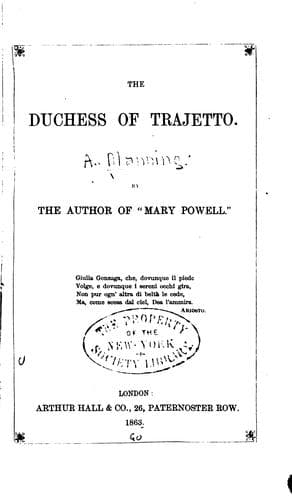
"The 'Alfabeto Christiano' is a book unknown even to bibliographers for
the last three centuries. It had its origin in an actual conversation
between Juan de Valdés, twin brother to the Latin secretary of the
Emperor Charles the Fifth, and Giulia Gonzaga, Duchess of Trajetto and
Countess of Fondi, at Naples, about the close of 1535, or the beginning
of the following year. At her request it was immediately afterwards
written down by him in Spanish, to promote her instruction and refresh
her memory. It now essentially conveys to us the spirit and substance of
the conversation in the precise form and manner in which it took place
between them."--_Introduction by Benjamin B. Wiffen, Esq., to his
translation of the "Alfabeto Christiano."_
"It was printed at a time when for a few years the press of Venice was
comparatively free; and when, taking advantage of this liberty, then
existing nowhere else in Italy, it multiplied the tracts of the
Reformation by thousands. When the friends of Valdés were afterwards
persecuted at Naples, and his name condemned by the authority of Rome,
implicating by connection with him, one of the most distinguished
members of the noble family of the Gonzagas,--all parties, friends
equally with opponents, would of course be concerned to observe silence
on the subject; while all the friends of the family would be urged alike
by religious sentiment and by family considerations to destroy silently
and irrecoverably every copy of a book that appeared to cast, by its
association with her name, the shadow of its principles upon those who
were allied to her."--_Ibid._
The passage describing the manner in which a stray copy fell into his
hands, and the circumstances under which he perused it, is one of the
pleasantest in Mr. Wiffen's Introduction. McCrie quotes a passage from
Fontaine, who tells us that "on taking down an old house at Urbino, in
1728, the workmen disinterred a copy of Bruccioli's 'Paraphrase of St.
Paul's Epistles,' with some books of Ochino, Valdés, and others of the
same kind, which had remained in concealment for more than a century and
a half."
III.
Public-domain text, read in full here on John Shaqi.
Reviews
Reviews
No reviews yet
Be the first to share your thoughts on this work.
Elsewhere in the archive
Join the Discussion
Join the discussion
Sign in to leave a comment or review.
Sign InorCreate an account