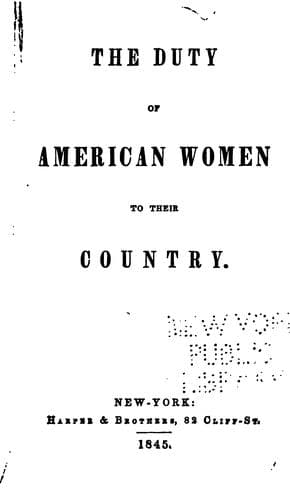
The Duty of American Women to Their CountryBeecher, Catharine Esther
History
The Duty of American Women to Their Country
Beecher, Catharine Esther
Education; Education -- United States; Women teachers -- United States
Are you dwelling in those parts of our land where most is done for
education, and comforting yourself that at least you and yours shall
escape in safety? But how can you tell that in five or ten years either
you, or those you love best, will not be the other side of the Alleghany,
and in the most destitute portion of the nation? The changes of fortune,
the pursuit of wealth, the mutations of matrimonial connexions, utterly
forbid any reliance on permanency of residence.
And how can one portion of this nation suffer and the other escape? Is
not the vast River Valley, whatever may be the character of its millions,
to hold the controlling power of our nation? If any portion of the fair
West be tortured with civil commotion and lawless rage, will not every
groan re-echo from the maternal heart of New-England and New-York, whose
sons and daughters are dwelling on every prairie and in every valley of
our land?
Mother, whose hands are so busy in ornamenting your darling child;
Sister, whose fingers fly so swiftly over the canvass or lace; Daughter,
so earnestly engaged in preparing your elegant habiliments, look back to
that beautiful daughter of emperors, that sister of kings, that mother
of princes, brought to her palace-home amid a nation’s transports, the
welcome bride of the nation’s heir.
Again, on the birth of her first-born, hear the triumphant pæan re-echoed
across the ocean, sung by the very children in our streets, and in the
memory of many now on the stage:
“A Dauphin’s born! let cannon loud
With echoes rend the sky;
All hail to Gallia’s King!
Columbia’s great ally!”
And thus the great English orator of that day describes her: “It is now
sixteen or seventeen years since I saw the Queen of France, then the
Dauphiness, at Versailles: and surely never lighted on this orb, which
she scarcely seemed to touch, a more delightful vision! I saw her, just
above the horizon, decorating and cheering the elevated sphere she just
began to move in, glittering like the morning star, full of life, and
splendour, and joy. Little did I dream I should have lived to see such
disasters fall upon her, in a nation of gallant men, in a nation of men
of honour and of cavaliers. I thought ten thousand swords would have
leaped from their scabbards to avenge even a look that threatened her
with insult.”
Look, now, through those prison bars. There, pale and mournful, upon a
pallet of straw, rests one for whom the splendours of Versailles scarcely
seemed enough. Her once bright locks, even in youth, are gray with fear
and sorrow. She is in solitude; her husband in one cell, and her weeping
children, torn from her and placed with brutal keepers, in another. And
now her husband is borne forth to a bloody death. Again her prison doors
unclose, and she comes forth, seated on the fatal car, her hands tied
behind her back, surrounded by thousands, who shout with malignant joy as
the fatal guillotine terminates her woes.
Public-domain text, read in full here on John Shaqi.
Reviews
Reviews
No reviews yet
Be the first to share your thoughts on this work.
Join the Discussion
Join the discussion
Sign in to leave a comment or review.
Sign InorCreate an account