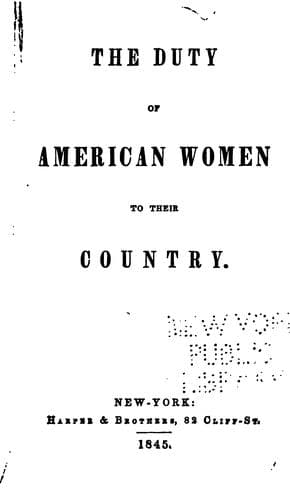
The Duty of American Women to Their CountryBeecher, Catharine Esther
History
The Duty of American Women to Their Country
Beecher, Catharine Esther
Education; Education -- United States; Women teachers -- United States
It could be stated to the objector, that in this country it is _the
majority_ that must decide every question not already settled by the
Constitutions of the state or nation. That, in regard to the question of
moral and religious training in the schools, the people are free to use
their own judgment. That where the majority wish to have such training a
part of school exercises, they have a right to require it. But in cases
where persons object to having their children so trained, the majority
have no right to insist on it. In order to avoid this, in every case
where a parent requests it, his children can be allowed to leave the
schoolroom while these exercises are going on, to study, or to perform
some other school duty. Or if this is inconvenient, they can be allowed
to come half an hour later, and then remain half an hour longer, after
the others are dismissed. No man could object to such an arrangement
without violating the first principle of our democracy, by demanding that
the _minority_, and not the _majority_, shall be accommodated in this
matter.
Now is it not practicable for every woman, who attempts to promote the
_proper_ education of American children, to use whatever influence she
may have with parents, or teachers to secure such a course of moral
training in the schools in her own vicinity, as is here indicated? Let
every woman _try_ what she can do to promote this important object.
American woman, whose eye may be resting on this page, are you willing
to commence an effort to aid in saving your country from the perils of
ignorance? Are you not spending more time in adorning your person, your
children, or your residence, or in social enjoyments, or in providing for
the gratification of the palate, than you have yet given to this cause?
Can you continue this unchristian, unpatriotic apportionment of time,
without an upbraiding conscience? Do you say that already you have more
to do than you can properly perform? But, in the list of your pursuits,
are there not some that are of far inferior consequence to this, which
it would do no harm to curtail, and thus gain time for this? Do you not
spend time and money for articles of dress, or ornaments, or in social
intercourse, or for needless luxuries, that you might, without any evil,
give up to this object?
Do you say that you can do but little, and relieve yourself from
obligation because it is so little? Suppose each drop of rain should urge
this plea, and thus delay to refresh the fields? Is not every great and
good work accomplished by _a union of many little influences_, and as
much so in the moral as in the natural world?
Public-domain text, read in full here on John Shaqi.
Reviews
Reviews
No reviews yet
Be the first to share your thoughts on this work.
Join the Discussion
Join the discussion
Sign in to leave a comment or review.
Sign InorCreate an account