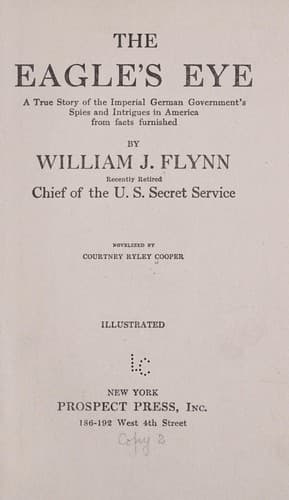
Espionage, German -- United States -- Fiction; Germans -- United States -- Fiction; Spy stories
He opened a drawer at the table at which he was sitting and after
unlocking a compartment within it produced a pair of field glasses.
Undoing a catch at the side divided the object into two sections
showing that the interior had been cunningly arranged as a camera. From
it he took two small cartridges of films.
"Some pictures, which will amuse Hindenburg," he said handing the
films to Von Papen. "They contain views of the military parade which
took place this morning, and as they were taken through two of the
finest microscopic lenses in the world enlarged prints will give him
much information about the state of training and the equipment of the
American army. To me it was an amusing sight, comparable to a chorus
in a musical comedy. They make a brave showing on dress parade, but
everyone knows that they are few in number, inadequate in equipment,
and with absolutely nothing in the way of preparation for a war."
"Tin soldiers who have no conception of discipline or the rudiments of
fighting," commented Von Papen. "I doubt if a quarter of a million men
could be induced to enter the army if America did declare war."
"The number who would respond would make no difference," said the
German Ambassador. "Untrained they would be slaughtered in France and
would leave less opposition to us here when 'Der Tag' arrives for
America. Four years is the least possible time in which a civilian may
be made into a soldier for it takes that time in Germany, working
with the most intelligent material in the world and with the best
equipped system. By that time, if training were attempted here, France
and England will be subjugated and America on the defense in its own
country."
Nods of approval from his three listeners gave assent to the fact that
he had but expressed an idea which they all held, in fact, a belief
which was held by the entire military party of Germany.
"And now we must say farewell," said Boy-Ed, "we will not see you again
for you must condone our indescretions and show your revulsion of our
methods by being unfriendly. For were you too friendly toward us, who
have betrayed you, why even the pig-headed Americans might be led to
suspect that Imperial Germany condoned, even if it did not sanction,
our activities here."
A hearty laugh followed this ironic sally, and then after leave
takings, Von Papen and Boy-Ed departed to take a train for New York,
where many things, in addition to their packing, remained to be done
before they sailed and the time was short.
Heinric von Lertz, Madam Augusta Stephan, Baroness Therese Verbecht and
Wolf von Igel, were in Von Papen's New York office when they arrived.
Public-domain text, read in full here on John Shaqi.
Reviews
Reviews
No reviews yet
Be the first to share your thoughts on this work.
Elsewhere in the archive
Join the Discussion
Join the discussion
Sign in to leave a comment or review.
Sign InorCreate an account