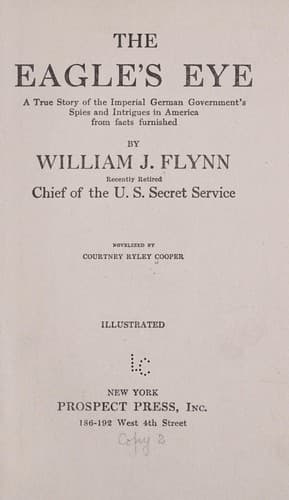
Espionage, German -- United States -- Fiction; Germans -- United States -- Fiction; Spy stories
With the soil samples from various fields arranged in neat piles on
the white paper Grant set to work on matters which were, for the most
part, mysterious to the farmer. A Bunsen burner was connected with
the chandelier in the room. Small portions of the soil from each pile
were placed in separate test tubes. Then each was heated, mixed with
small portions of the matter from the various bottles and packages
which had been gotten at the drug store. Each test tube was treated in
identically the same way and as he finished with each one Grant entered
figures in his note book. He was working on the last tube when a knock
came on the door, and in response to Grant's "Come" the door opened
and Dixie Mason entered. The little Secret Service operative remained
silent while Grant finished the test tube. He jotted some figures in
his note book, then snapped it shut, and turned toward her smiling.
"You have discovered something?" Dixie asked.
"I think so," answered Grant. "But first let us hear what you have
discovered, to see if it fits in with my find."
"It isn't an awful lot," answered Dixie. "In the first place every
fire has started in the portion of the field nearest to the road or a
railroad, and almost invariably there has been water near the place
where the fire started. The only strangers which have been observed in
the vicinity were a couple of traveling geologists, who did most of
their traveling on foot and carried the samples they had collected in
little cloth bags. That is about all."
"It is enough," said Grant. "The point of origin of the fire in the
first field I examined attracted my attention because it had been
burned with a more intense heat than burning grain would make. I took
a sample there and then for purposes of comparison took another sample
of the soil some distance away. It was easy to determine the place of
the origin of the fires in the other fields, for in each place I found
a spot where there had been intense heat. The samples from these spots
which I have analyzed show a large percentage of phosphorus oxide,
while the other samples are free from it. Phosphorus oxide is formed by
the burning of phosphorus."
"Which makes it very clear as to how the fires started," commented
Dixie.
"It may be to you," interjected the farmer, "but I can't see what
started the phosphorus burning even if some was placed in the field."
Public-domain text, read in full here on John Shaqi.
Reviews
Reviews
No reviews yet
Be the first to share your thoughts on this work.
Elsewhere in the archive
Join the Discussion
Join the discussion
Sign in to leave a comment or review.
Sign InorCreate an account