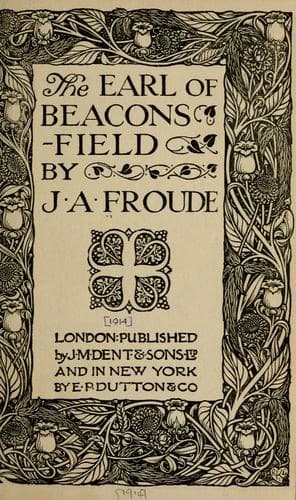
He was now to show whether he was or was not a really great man. In his
early career he had not concealed that his chief motive was ambition. He
had started as a soldier of fortune, and he had taken service with the
party among whom, perhaps, he felt that he would have the best chance of
rising to eminence. Young men of talent were chiefly in the other
camp--among the Conservatives he might expect fewer rivals. But the side
which he had chosen undoubtedly best suited the character of his own
mind; under no circumstances could Disraeli have been a popular apostle
of progress, or have taught with a grave face the doctrines of visionary
freedom. He regarded all that as nonsense, even as insincere nonsense,
not believed in even by its advocates. On all occasions he had spoken
his mind freely, careless what prejudice he might offend. Even on the
abolition of slavery, on which English self-applause was innocently
sensitive, he alone of public men had dared to speak without enthusiasm.
The emancipation of the negroes, he said in a debate upon the sugar
trade, 'was virtuous but was not wise.' Politics was his profession, and
as a young barrister aspires to be Lord Chancellor Disraeli aspired to
rise in the State. He had done the Conservatives' work, and the
Conservatives had made him Prime Minister; but he had committed himself
to few definite opinions, and, unlike most other great men who had
attained the same position, he was left with a comparatively free hand.
Lord Burghley was called to the helm to do a definite thing; to steer
his country through the rocks and shoals of the Reformation. His course
was marked out for him, and the alternatives were success or the
scaffold. Disraeli had the whole ocean open, to take such course as
might seem prudent or attractive. There was no special measure which he
had received a mandate to carry through, no detailed policy which he had
advocated which the country was enabling him to execute. He was
sincerely and loyally anxious to serve the interests of the British
Empire and restore its diminished influence, but in deciding what was to
be done it was natural that he would continue to be guided by an
ambition to make his Ministry memorable, and by the cosmopolitan and
oriental temperament of his own mind.
Public-domain text, read in full here on John Shaqi.
Reviews
Reviews
No reviews yet
Be the first to share your thoughts on this work.
Elsewhere in the archive
Join the Discussion
Join the discussion
Sign in to leave a comment or review.
Sign InorCreate an account