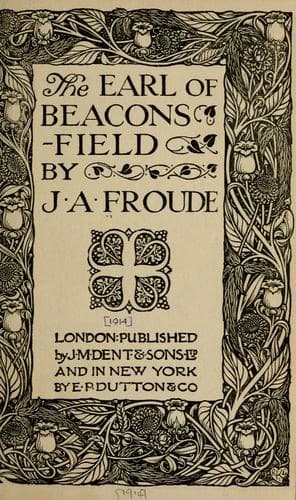
Disraeli's speeches during Peel's Ministry and the effects which they
produced can be touched but superficially in a narrative so brief as
this, but they formed the turning-point of his public life. His assaults
when he began were treated with petulant contempt, but his fierce
counter-hits soon roused attention to them. The Liberals were
entertained to see the Conservative chief dared and smitten by one of
his own followers. The country members felt an indignant satisfaction at
the deserved chastisement of their betrayer. The cheers in Parliament
were echoed outside the walls and rang to the farthest corner of the
Continent. With malicious skill Disraeli touched one after the other the
weak points of a character essentially great but superficially
vulnerable. Like Laertes he anointed his point, but the venom lay in the
truth of what he said, and the suffering which he inflicted was the more
poignant because administered by a hand which Peel had unfortunately
despised. Disraeli was displaying for the first time the peculiar
epigrammatic keenness which afterwards so much distinguished him, and
the skill with which he could drive his arrows through the joints in
the harness. Any subject gave him an opening. Peel supposed that he had
rebuked and silenced him by quoting in a dignified tone Canning's lines
upon 'A Candid Friend.' The allusion was dangerous, for Peel's conduct
to Canning had not been above reproach. Disraeli took an occasion when
the general policy of the Ministry was under discussion to deliver
himself in his clear, cold, impassive manner of a few sentences which
hit exactly the temper of the House. Peel was generally accused of
having stolen the Liberal policy. The right honourable gentleman, he
said, had caught the Whigs bathing and had walked away with their
clothes. He had tamed the shrew of Liberalism by her own tactics. He was
the 'political Petruchio who had outbid them all.' Then came the sting.
Peel had a full memory, and was rather proud of the readiness with which
he could introduce quotations. Disraeli first touched his vanity by
complimenting him on the success with which he used such weapons,
'partly because he seldom quoted a passage which had not previously
received the meed of Parliamentary approbation, partly because his
quotations were so happy.... We all admire Canning,' he said; 'we all,
or at least most of us, deplore his untimely end. We sympathised with
him in his fierce struggle with supreme prejudice and sublime
mediocrity, with inveterate foes and with candid friends. Mr. Canning!
and quoted by the right honourable gentleman. The theme, the poet, the
speaker!--what a felicitous combination!'
Public-domain text, read in full here on John Shaqi.
Reviews
Reviews
No reviews yet
Be the first to share your thoughts on this work.
Elsewhere in the archive
Join the Discussion
Join the discussion
Sign in to leave a comment or review.
Sign InorCreate an account