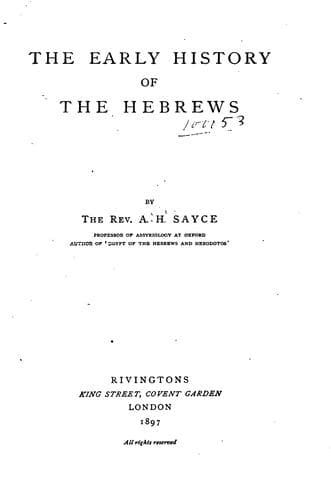
The early history of the HebrewsSayce, A. H. (Archibald Henry)
History
The early history of the Hebrews
Sayce, A. H. (Archibald Henry)
Bible. Old Testament -- Criticism, interpretation, etc.; Jews -- History -- To 953 B.C.
Thus, then, directly or indirectly, much of the history contained in the
Pentateuch has been shown by archæology to be authentic. And it must be
remembered that Oriental archæology is still in its infancy. Few only of
the sites of ancient civilisation have as yet been excavated, and there
are thousands of cuneiform texts in the Museums of Europe and America
which have not as yet been deciphered. It was only in 1887 that the Tel
el-Amarna tablets, which have had such momentous consequences for
Biblical criticism, were found, and the disclosures made by the early
contracts of Babylonia, even the name of Chedor-laomer itself, are of
still more recent discovery. It is therefore remarkable that so much is
already in our hands which confirms the antiquity and historical
genuineness of the Pentateuchal narratives; and it raises the
presumption that with the advance of our knowledge will come further
confirmations of the Biblical story. At any rate, the historian’s path
is clear; the Pentateuch has been tested by the comparative method of
science, and has stood the test. It contains history, and must be dealt
with accordingly like other historical works. The philological theory
with its hair-splitting distinctions, its Priestly Code and ‘redactors,’
must be put aside, along with all the historical consequences which it
involves.
But it does not follow that because the philological theory is
untenable, all inquiries into the character and sources of the
Pentateuch are waste of time. The philological theory has failed because
it has attempted to build up a vast superstructure on very imperfect and
questionable materials; because, in short, it has attempted to attain
historical results without the use of the historical method. But no one
can study the Pentateuch in the light of other ancient works of a
similar kind without perceiving that it is a compilation, and that its
author—or authors—has made use of a large variety of older materials.
Modern Oriental history has been written in the same manner; a book, for
instance, like the Egyptian history of El-Maqrîzî, though the production
of a single mind, nevertheless embodies older materials which have been
collected from every side. The Egyptian Book of the Dead, or the
Chaldæan Epic of Gilgames, bears the same testimony. The growth of the
Book of the Dead, the ritual which was needed by the souls of the
Egyptian dead in their passage to the next world, can actually be
traced.[139] It included and combined the doctrines of more than one
school of early Egyptian theological thought, and in later days was
extensively interpolated and modernised. Not only were glosses, once
intended to explain the obscurities of the archaic phraseology,
incorporated into the text, but even whole chapters were added to the
work. The Epic of Gilgames similarly embodies other poems or portions of
poems, of which the Episode of the Deluge is an example. Yet no
Public-domain text, read in full here on John Shaqi.
Reviews
Reviews
No reviews yet
Be the first to share your thoughts on this work.
Elsewhere in the archive
Join the Discussion
Join the discussion
Sign in to leave a comment or review.
Sign InorCreate an account