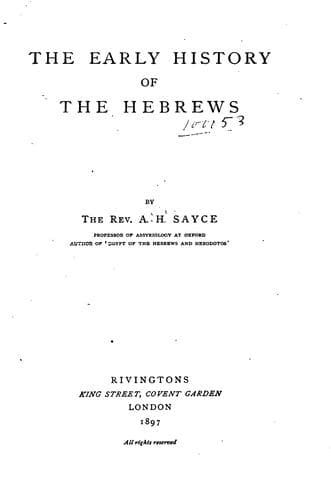
The early history of the HebrewsSayce, A. H. (Archibald Henry)
History
The early history of the Hebrews
Sayce, A. H. (Archibald Henry)
Bible. Old Testament -- Criticism, interpretation, etc.; Jews -- History -- To 953 B.C.
Here, therefore, the limit of age prescribed by archæology forbids us to
pass beyond the Mosaic epoch. Moses, in short, is the compiler to whom
the archæological evidence indicates that the tenth chapter of Genesis
goes back in its original shape. But by the side of this evidence there
is other evidence also which tells a different tale. Gomer, or the
Kimmerians, as well as Madai, are named among the sons of Japhet, and
the Assyrian monuments assure us that neither the one nor the other came
within the geographical horizon of Western Asia before the ninth century
B.C. It was in the ninth century B.C. that the Assyrian kings first
became acquainted with the Medes, while the Gimirrâ or Kimmerians did
not descend upon Asia from their seats on the Sea of Azof until about
B.C. 680. The same reasoning which gives us the Mosaic age as that of
the geographical chart of Genesis in its primitive shape gives us the
seventh century B.C. or later for the date of another portion of the
same chapter.
The list of the kings of Edom, again, is introduced by the remark that
‘these are the kings that reigned in the land of Edom, before there
reigned any king over the children of Israel.’ It was not inserted in
the book of Genesis, therefore, until after the age of Saul, a
conclusion which is supported by the fact that the first king named
seems to be Balaam, the son of Beor, who was a contemporary of Moses.
If, accordingly, the Pentateuch was originally compiled in the Mosaic
age, it must have undergone the fate of the Egyptian Book of the Dead,
and been enlarged by subsequent additions. Insertions and interpolations
must have found their way into it as new editions of it were made.
That such was the case there is indirect testimony. On the one hand the
text of the prophetical books was treated in a similar manner, additions
and modifications being made in it from time to time by the prophet or
his successors in order to adapt it to new political or religious
circumstances. Isaiah, for instance, has copied a prophecy directed by
one of his predecessors against Moab; and after breaking it off in the
middle of a sentence, has adapted it to the needs and circumstances of
his own time. On the other hand, a long-established Jewish tradition,
which has found its way into the Second Book of Esdras (xiv. 21-26),
makes Ezra rewrite or edit the books of Moses. There is no reason to
question the substantial truth of the tradition; Ezra was the restorer
of the old paths, and the Pentateuch may well have taken its present
shape from him. If so, we need not be surprised if we find here and
there in it echoes of the Babylonish captivity.
Public-domain text, read in full here on John Shaqi.
Reviews
Reviews
No reviews yet
Be the first to share your thoughts on this work.
Elsewhere in the archive
Join the Discussion
Join the discussion
Sign in to leave a comment or review.
Sign InorCreate an account