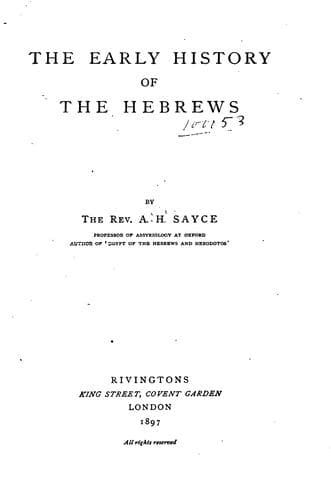
The early history of the HebrewsSayce, A. H. (Archibald Henry)
History
The early history of the Hebrews
Sayce, A. H. (Archibald Henry)
Bible. Old Testament -- Criticism, interpretation, etc.; Jews -- History -- To 953 B.C.
Such, then, are the main results of the application of the archæological
test to the books of the Pentateuch. The philological theory, with its
minute and mathematically exact analysis, is brushed aside; it is as
little in harmony with archæology as it is with common sense. The
Pentateuch substantially belongs to the Mosaic age, and may therefore be
accepted as, in the bulk, the work of Moses himself. But it is a
composite work, embodying materials of various kinds. Some of these are
written documents, descriptive of contemporaneous events, or recording
the cosmological beliefs of ancient Babylonia; others have been derived
from the unwritten traditions of nomad tribes. The work has passed
through many editions; it is full of interpolations, lengthy and
otherwise; and it has probably received its final shape at the hands of
Ezra. But in order to discover the interpolations, or to determine the
written documents that have been used, we must have recourse to the
historical method and the facts of archæology. Apart from these we
cannot advance a step in safety. The archæological evidence, however, is
already sufficient for the presumption that, where it fails us, the text
is nevertheless ancient, and the narrative historical—a presumption, it
will be noticed, the exact contrary of that in which the Hexateuchal
theory has landed its disciples.
But, these same disciples will urge, what becomes of those three strata
of legislation which we have so successfully disentangled one from the
other in the Hexateuch, and have shown to belong to three separate and
mutually exclusive periods of Israelitish history? Has not literary
criticism proved that no reconciliation is possible between the
enactments and point of view of the Book of the Covenant on the one
side, and those of the Deuteronomist on the other, or between the
legislation of the Deuteronomist and that of the Priestly Code? The
altar of earth or rough-hewn stones, which may be built on any high
place, makes way for the altar of the temple at Jerusalem, and this
again for the ideal altar of the tabernacle in the wilderness. One
sanctuary takes the place of many; the priesthood is confined first to
the tribe of Levi, and then more especially to the sons of Aaron; while
the simple feasts of harvest rejoicing, which were celebrated by early
Israel in common with its neighbours, are replaced by sacrifices for sin
and solemn festivals like the Day of Atonement.
Public-domain text, read in full here on John Shaqi.
Reviews
Reviews
No reviews yet
Be the first to share your thoughts on this work.
Elsewhere in the archive
Join the Discussion
Join the discussion
Sign in to leave a comment or review.
Sign InorCreate an account