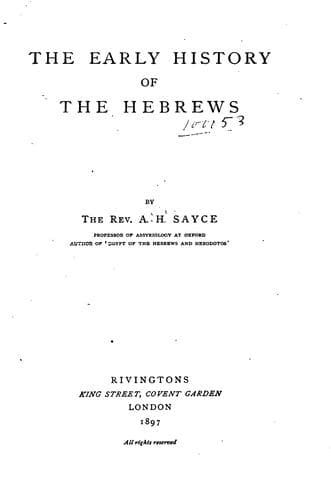
The early history of the HebrewsSayce, A. H. (Archibald Henry)
History
The early history of the Hebrews
Sayce, A. H. (Archibald Henry)
Bible. Old Testament -- Criticism, interpretation, etc.; Jews -- History -- To 953 B.C.
Dr. Clay Trumbull has shown that the Passover was but an adaptation of
the old rite which he terms the ‘Threshold Covenant.’[177] It was a rite
which went back to the earliest age of mankind, and of which we find
traces in many parts of the world. Even in the Egypt of to-day the
building of a new house or boat is not complete without the slaughter of
a sheep, the blood of which is allowed to fall on the threshold of the
house or the deck and side of a vessel. The blood was the mark of the
sacrifice by which the master of the house entered into covenant with
the stranger, or even with his god. Where it appeared the avenging deity
passed by, mindful of the covenant, and remembering that the house
contained a friend and not an enemy. The threshold became an altar, and
those who passed over it were made members of the family, and shared
with them their rights and their religion. When once the bride had
crossed the threshold of her new home, she left behind her all her old
ties and relations, and became a member of a new family.
To quote the words of Dr. Clay Trumbull, ‘Long before’ the night of the
Exodus, ‘a covenant welcome was given to a guest who was to become as
one of the family, or to a bride or bridegroom in marriage, by the
outpouring of blood on the threshold of the door, and by staining the
doorway itself with the blood of the covenant. And now,’ on the eve of
the flight from Goshen, ‘Jehovah announced that He was to visit Egypt on
a designated night, and that those who would welcome Him should prepare
a threshold covenant, or a passover sacrifice, as a proof of that
welcome; for where no such welcome was made ready for Him by the family,
He must count the threshold as His enemy.’[178]
The belief that sacrifice alone could secure the house from the wrath of
Heaven has been spread widely over the world. Numberless traces of it
are to be found in the folklore of Europe. Popular legend knows of
bridges and castles which refused to stand until the human victim had
been buried beneath their foundations, and even S. Columba was held to
have been unable to build his cathedral at Iona until his companion Oran
had been immured alive beneath its foundation-stones. We learn from the
Old Testament that the belief was strong among the Israelites also. When
Hiel of Beth-el rebuilt the ruined Jericho, we are told that ‘he laid
the foundation thereof in Abiram his firstborn, and set up the gates
thereof in his youngest son Segub’ (1 Kings xvi. 34). The Deity had a
right to the firstborn; and if this right were not recognised by the
sacrifice either of the firstborn himself or of a substitute, there
could be no covenant between the family and its gods. A new building
implied a new local habitation for the family and the gods it
worshipped; and where there was no covenant between them, the gods would
come as foes and not as friends.
Public-domain text, read in full here on John Shaqi.
Reviews
Reviews
No reviews yet
Be the first to share your thoughts on this work.
Elsewhere in the archive
Join the Discussion
Join the discussion
Sign in to leave a comment or review.
Sign InorCreate an account