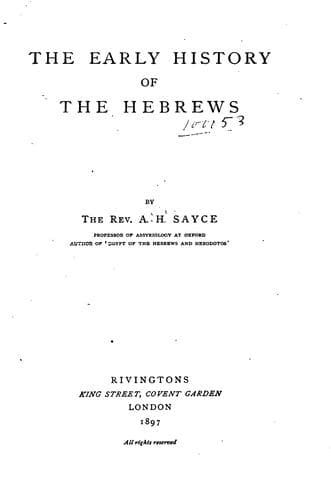
The early history of the HebrewsSayce, A. H. (Archibald Henry)
History
The early history of the Hebrews
Sayce, A. H. (Archibald Henry)
Bible. Old Testament -- Criticism, interpretation, etc.; Jews -- History -- To 953 B.C.
Jethro’s visit marked the first step in the organisation of Israel.
Under his guidance and counsel judges of various grades were appointed
before whom minor cases could be brought, and each of whom was invested
with a certain amount of power. The functions of the ‘judge’ were
administrative and executive as well as legal; what was meant by the
term we may learn from the book of Judges as well as from the Shophetim
or judges who at one time took the place of the kings at Tyre. They
corresponded closely with the higher officials in the Turkish provinces,
who possess an undefined and in some respects absolute authority,
subject only to the official who is immediately above them. The ‘judges’
established by Moses on Jethro’s advice derived their titles from the
numerical extent of their jurisdiction. They were judges ‘of thousands,’
‘of hundreds,’ ‘of fifties,’ and ‘of tens.’ The community was divided
into ideal units, of larger and smaller size, the basis of the
arrangement being the decimal system. The whole arrangement may have
been of Midianite origin; at all events, in the Assyrian texts we hear
also of a ‘captain of fifty’ and a ‘captain of ten.’[196]
Moses remained the supreme ‘judge’ and lawgiver of his people. To him
alone all ‘great matters’ were referred, and from him came all the laws
and ordinances, the rules and regulations which they were called upon to
obey. The leader who had brought them safely out of ‘the house of
bondage’ now became their recognised head and legislator. Moses ‘was
king in Jeshurun,’ exercising all the authority in Israel which in later
times belonged to the king.
Hardly was the political organisation of the new community completed
before the Israelitish tribes reached the venerated sanctuary of Sinai,
and encamped before ‘the Mount of God.’ The first object of their
journey was accomplished, and the promise of Yahveh was fulfilled that
they should ‘serve God’ on the mountain where He had appeared to their
leader. Here at Sinai the earlier portion of the Mosaic legislation was
promulgated. It was subsequently supplemented by the legislation at
Kadesh-Barnea, that second resting-place of the tribes, where by the
side of En-Mishpat, ‘the Spring of Judgment,’ they prepared themselves
in the security of the heart of the desert for the future invasion of
Canaan.
Public-domain text, read in full here on John Shaqi.
Reviews
Reviews
No reviews yet
Be the first to share your thoughts on this work.
Elsewhere in the archive
Join the Discussion
Join the discussion
Sign in to leave a comment or review.
Sign InorCreate an account