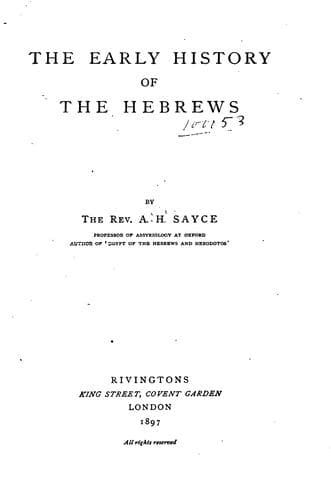
The early history of the HebrewsSayce, A. H. (Archibald Henry)
History
The early history of the Hebrews
Sayce, A. H. (Archibald Henry)
Bible. Old Testament -- Criticism, interpretation, etc.; Jews -- History -- To 953 B.C.
In Egypt, too, the gods had their shrines, though these were usually
boats which on the days of festival floated over the sacred lakes. Arks,
however, were not unknown, and, as in Babylonia, contained the images of
the gods. Sometimes, however, in Babylonia and Assyria, the ark, like
that of Israel, had no image within it: the stone coffer, for instance,
found by Mr. Hormuzd Rassam in the inner sanctuary of the little temple
of Balawât contained two tables of alabaster on which the annals of king
Assur-nazir-pal were engraved. The native workmen who discovered them
naturally saw in them the two tables of stone which had been similarly
placed by Moses in the ark (Deut. x. 5).[203]
The parallelism between the temples and ritual of Israel and of
Babylonia is indeed close. The temple itself was of the same square or
rectangular form. Outwardly it presented the appearance of a huge box.
Within were the forecourt and court, while at the back came the Holy of
Holies, with its altar and ark. There was, however, one distinguishing
feature in the Babylonian temple which was lacking in the Hebrew
tabernacle. That was the great tower which mounted up towards heaven,
and the topmost stage of which seemed to approach the gods. In the
absence of a tower the Hebrew tabernacle agreed with the temples of
Canaan.
The Israelitish altars found their counterpart in Babylonia. So, too,
did the table of shewbread, which similarly stood in the sanctuaries of
the Chaldæan deities. The sacrifices and offerings were also similar.
Babylonia had its daily sacrifice. its ‘meal-offering,’ and its
offerings for sin; the same animals that were sacrificed to Yahveh were
sacrificed also to Bel; and the Babylonian worshipper sought the favour
of his gods with the same birds and the same fruits of the field. Oil,
moreover, was used for purposes of anointing, and herein the ritual of
Babylonia and Israel differed from that of Egypt, where oil was not
employed.[204]
The contrast between Egypt and Israel, indeed, in the details of
religious service was as great as the agreement in this respect between
Israel and Babylonia. The children of Israel had never forgotten their
Asiatic origin; throughout their long sojourn in Goshen they had
preserved their old culture and habits of thought as tenaciously as they
had preserved their language. Between them and the Egyptians, on the
contrary, there had been antagonism from the outset. And this antagonism
was accentuated by their lawgiver, who was naturally anxious to turn
their thoughts from ‘the fleshpots of Egypt,’ and to prevent them from
lapsing into Egyptian idolatries. Even the Egyptian legend of the Exodus
bears witness to this fact.
Public-domain text, read in full here on John Shaqi.
Reviews
Reviews
No reviews yet
Be the first to share your thoughts on this work.
Elsewhere in the archive
Join the Discussion
Join the discussion
Sign in to leave a comment or review.
Sign InorCreate an account