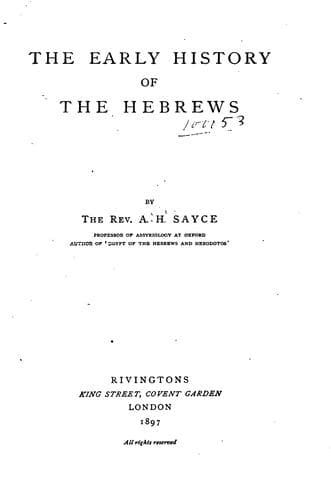
The early history of the HebrewsSayce, A. H. (Archibald Henry)
History
The early history of the Hebrews
Sayce, A. H. (Archibald Henry)
Bible. Old Testament -- Criticism, interpretation, etc.; Jews -- History -- To 953 B.C.
The Levitical legislation was accompanied by a census of the people.
What credit we are to attach to the numbers which have been handed down
is a question that has been much debated. On the one hand it has been
shown that the vast multitude presupposed by them could not have moved
about in the desert, as it is represented to have done, and that many of
the regulations in the Levitical Code could not have been carried out
with a nomad population of over two millions.[216] On the other hand,
the 600,000 men above twenty years of age who were ‘able to go forth to
war’ are specified again and again, and the same number is implied in
all the calculations that are made of the numerical strength of Israel.
It is also the sum of the numbers assigned to the fighting men of the
individual tribes. Throughout the history the ciphers are consistent
with one another. If the number is exaggerated, it it is an exaggeration
which has been consistently adhered to. We must either accept it, or
believe that it belongs to an artificial system which has been framed
with deliberate intention. But the same may be said of the chronology of
the early patriarchs as well as of the chronology of the kings of Israel
and Judah, and in both instances we know that the system is wrong. In
the case of the chronology of the early patriarchs, indeed, there are at
least three rival systems, all equally complete and self-coherent, while
the chronology of the kings involves such hopeless anachronisms as have
long since caused it to be rejected by the historian. The difficulties
presented by the census of the Israelites in the wilderness are similar
in character to the anachronisms presented by the chronology of the
kings, and the same reasons which lead us to reject the one ought
equally to induce us to reject the other.
Nevertheless, the chronology of the kings is not wholly incorrect. The
length of reign assigned to the several kings is usually right. It is
only the system into which it has been fitted that is at fault. And
probably this is also the case as regards the numbering of the tribes of
Israel. It may be that the 8580 Levites and the 22,273 firstborn males
are authentic, and that the increase of the population by 3550 (Exod.
xxxviii. 26; Numb. i. 46) a few months after the flight from Egypt, and
its decrease by 1820 at the end of the wanderings (Numb. xxvi. 51), rest
on a foundation of fact. Even the traditional number of 600,000 may have
better support than its being a multiple of the Babylonian _soss_ and
_ner_.[217] Perhaps it originally represented the whole body of
fugitives from Egypt.
Public-domain text, read in full here on John Shaqi.
Reviews
Reviews
No reviews yet
Be the first to share your thoughts on this work.
Elsewhere in the archive
Join the Discussion
Join the discussion
Sign in to leave a comment or review.
Sign InorCreate an account