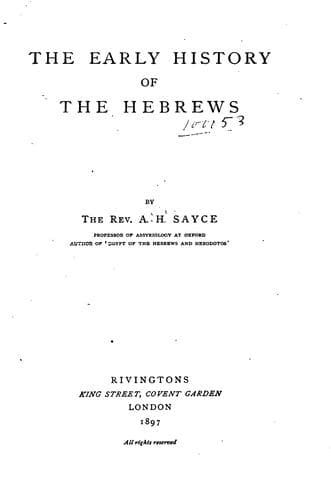
The early history of the HebrewsSayce, A. H. (Archibald Henry)
History
The early history of the Hebrews
Sayce, A. H. (Archibald Henry)
Bible. Old Testament -- Criticism, interpretation, etc.; Jews -- History -- To 953 B.C.
The guiding column of cloud moved accordingly from the wilderness of
Sinai to that of Paran (Numb. x. 12). This is in harmony with the rest
of Old Testament geography. In the blessing of Moses (Deut. xxxiii. 2)
it is said that when God came from Sinai, ‘He shined forth from the
mount of Paran,’ and in Habakkuk (iii. 3) the mount of Paran takes the
place of Sinai itself. Paran, in fact, was the desert which formed not
only the southern boundary of Canaan, but also the western frontier of
Edom. The real Mount Sinai of Hebrew geography, therefore, was upon the
Edomite border; and since Paran was the home of Ishmael (Gen. xxi. 21),
it is not surprising that Esau should have taken one of Ishmael’s
daughters to wife (Gen. xxxvi. 3).
Before Sinai was left, however, Hobab the Midianite, the brother-in-law
of Moses, proposed to return to his own land. Sinai adjoined Midian, if
indeed it was not included in Midianitish territory, and here,
therefore, if at all, it was needful for the Midianite chief to quit the
Israelitish camp. But his knowledge of the district was too valuable to
be lost, and Moses persuaded him to remain with the Israelitish tribes
and guide them to the places where they should encamp. The Kenites in
later days traced their descent to him (Judg. i. 16, iv. 11), and the
rocky nest of the Kenites was visible from the heights of Moab, perhaps
in Petra itself (Numb. xxiv. 21).
The geographical details which follow are confused. In the itinerary
(Numb. xxxiii. 15, 16) the camp is transported at once from the
wilderness of Sinai to Kibroth-hattaavah. In the narrative, however, we
are told that the people first went ‘three days’ journey,’ and then
rested at Taberah, which seems to be identified with Kibroth-hattaavah;
from thence they travelled to Hazeroth, and then pitched their tents ‘in
the wilderness of Paran.’ On the other hand, the book of Deuteronomy
(ix. 22) distinguishes between Taberah and Kibroth-hattaavah, and
interpolates Massah between them, which, according to Exod. xvii. 7, was
visited before Sinai. If we follow the official record, we must suppose
that the incident connected with Taberah has been inserted in the wrong
place, or else that Taberah and Kibroth-hattaavah are, like Massah and
Meribah, one and the same. At all events, all these encampments must
have lain on the outskirts of the desert of Paran. Hazeroth, ‘the
enclosures,’ was a common name for the Bedâwin encampments in the desert
south of Judah, and the Hazeroth mentioned here is doubtless that of
which we read in Deut. i. 1. It lay near Paran on the borders of the
plains of Moab.
Public-domain text, read in full here on John Shaqi.
Reviews
Reviews
No reviews yet
Be the first to share your thoughts on this work.
Elsewhere in the archive
Join the Discussion
Join the discussion
Sign in to leave a comment or review.
Sign InorCreate an account