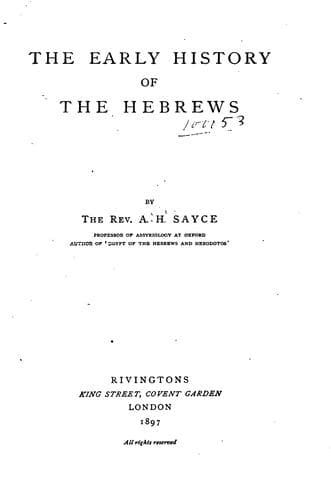
The early history of the HebrewsSayce, A. H. (Archibald Henry)
History
The early history of the Hebrews
Sayce, A. H. (Archibald Henry)
Bible. Old Testament -- Criticism, interpretation, etc.; Jews -- History -- To 953 B.C.
The story of Balaam seems to form an episode by itself. The narrative
and the prophecies constitute a single whole, which cannot be torn
apart. It is the first example in the Old Testament of a written
prophecy, and that the prophet should have been a Gentile diviner is of
itself significant. Nothing can be more vivid and lifelike than the
picture that is presented to us. We see the ambassadors of Balak
persuading the half-reluctant seer to accompany them; we read of the
strange miracles that accompanied the journey, and of the altars that
were reared, and the sacrifices that were offered in the hope that his
enchantments might prevail over those of Israel. He was taken from
high-place to high-place, whence he could look down upon the distant
hosts of the enemy, and upon each, in Babylonian fashion, seven altars
were erected. But all was unavailing. The God of Jacob refused to be
turned from His purpose by the bullocks and the rams that were offered
Him, and the curses of the Aramæan seer were turned into blessings. When
Balaam fell into the prophetic trance, seeing ‘the vision of the
Almighty, but having his eyes open,’ the words which were put into his
mouth were words which predicted the future glories of Israel. ‘A star
should come out of Jacob, and a sceptre should arise out of Israel,
which should smite the corners of Moab and destroy all the children of
Sheth.’[241] Edom, too, should at last become the possession of his
younger brother, and the Amalekites of the desert should perish for
ever.
Public-domain text, read in full here on John Shaqi.
Reviews
Reviews
No reviews yet
Be the first to share your thoughts on this work.
Elsewhere in the archive
Join the Discussion
Join the discussion
Sign in to leave a comment or review.
Sign InorCreate an account