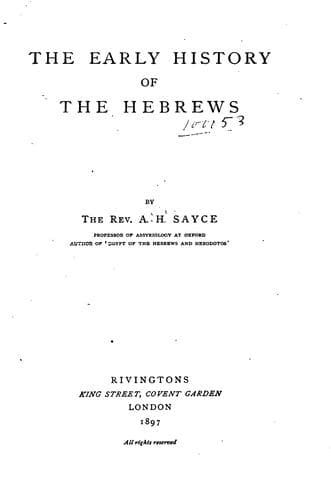
The early history of the HebrewsSayce, A. H. (Archibald Henry)
History
The early history of the Hebrews
Sayce, A. H. (Archibald Henry)
Bible. Old Testament -- Criticism, interpretation, etc.; Jews -- History -- To 953 B.C.
The first chapter of Judges tells us in outline what the map of
Palestine was like after the settlement of the Israelitish tribes. In
the south the mountainous country was held by the Edomite tribe of Caleb
as well as by the more strictly Israelitish tribe of Judah. But it was
only ‘the mountain’ that was thus held. Though ‘the Lord was with
Judah,’ he ‘could not drive out the inhabitants of the valley, because
they had chariots of iron.’ Further south, however, Judah and Simeon in
combination succeeded in making themselves masters of the Negeb or
desert plain as far as Zephath, where a mixed population, partly
Israelitish, partly Edomite, and partly Kenite, took the place of the
older inhabitants.
Jerusalem remained in the hands of the Jebusites until it was captured
by David. It is true, we read (Judg. i. 8) that ‘the children of Judah
had fought against Jerusalem, and had taken it and smitten it with the
edge of the sword.’ But if so, it must soon have been again fortified by
its former possessors, since we are expressly told (Judg. i. 21) that
the children of Benjamin did not drive out the Jebusites that inhabited
Jerusalem; but the Jebusites ‘dwell with the children of Judah in
Jerusalem unto this day.’[255] Modern critics have been in the habit of
dismissing the alleged capture of the city as unhistorical, but it is
quite possible that Jerusalem really suffered momentarily from a sudden
raid. The capture of the city is not ascribed to Joshua—indeed, though
he defeated its king and his allies, he seems to have made no effort to
reduce the city itself—and it is said to have been effected by Judah
after Joshua’s death. This may have been at any time during the period
of the Judges. The Tel el-Amarna tablets show us how easily the cities
of Canaan could be taken and retaken in the course of local quarrels,
and the fact that Jerusalem was for a while in Jewish hands seems to
form an integral part of the story of the conquest of Bezek.
Public-domain text, read in full here on John Shaqi.
Reviews
Reviews
No reviews yet
Be the first to share your thoughts on this work.
Elsewhere in the archive
Join the Discussion
Join the discussion
Sign in to leave a comment or review.
Sign InorCreate an account