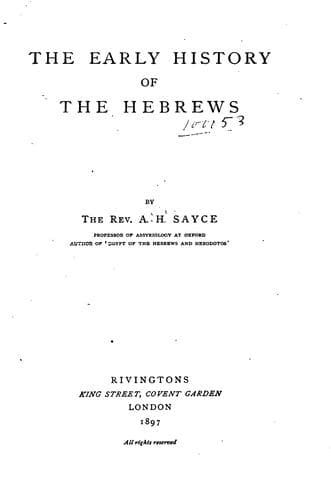
The early history of the HebrewsSayce, A. H. (Archibald Henry)
History
The early history of the Hebrews
Sayce, A. H. (Archibald Henry)
Bible. Old Testament -- Criticism, interpretation, etc.; Jews -- History -- To 953 B.C.
But it does not follow that because there was one king of Hazor called
Jabin, there should not have been another of the same name. Such
repetitions of name have been common in other countries of the world,
and it is difficult to see why the rulers of Hazor should not be allowed
a similar privilege. That a city should rise from its ruins and recover
its former power is again no unique event. Much depends upon its
position and the character of its inhabitants. We gather from the
Egyptian annals that the towns of Canaan were accustomed to capture and
temporary destruction. But they soon recovered themselves, the old
population flocked back, and their ruined walls were again repaired.
It is true that the conquest of the country by Joshua could not have
been as thorough as the narrative describes. But that we already knew
from the first chapter of Judges (vv. 30-33). Oriental expressions and
modes of thought are not to be measured by the precise terminology of
the modern West, and an Eastern writer speaks absolutely where we should
speak relatively. When it is said that ‘all the earth sought to Solomon,
to hear his wisdom’ (1 Kings x. 24), the universality of the statement
must be very considerably limited, and so too when it is said that
‘Joshua took all that land’ (Josh. xi. 16), the expression admits of a
similarly liberal discount. In fact, the narrative itself contains its
own corrective. The words, ‘All the cities of those kings ... did Joshua
take, and smote them with the edge of the sword, and utterly destroyed
them’ (ver. 12), are followed immediately by the conditioning clause,
‘Only the cities which were built upon _tels_, Israel burned none of
them: Hazor alone did Joshua burn.’
Between the story of Joshua’s campaign and that of the rising under
Barak there is no resemblance whatever. In the time of the Hebrew judge
the army of Jabin was commanded by Sisera, not by Jabin himself. The
decisive battle took place on the banks of the Kishon, not on the shores
of Lake Hûleh, miles away to the north, and the city of Hazor was
neither captured nor destroyed. Kadesh of Galilee and other districts
were already in the hands of the Israelites, and must therefore have
been occupied by them at some earlier period. The account in the book of
Joshua, brief as it is, tells us when the occupation took place.
Public-domain text, read in full here on John Shaqi.
Reviews
Reviews
No reviews yet
Be the first to share your thoughts on this work.
Elsewhere in the archive
Join the Discussion
Join the discussion
Sign in to leave a comment or review.
Sign InorCreate an account