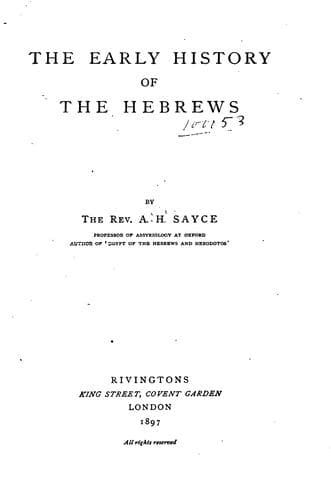
The early history of the HebrewsSayce, A. H. (Archibald Henry)
History
The early history of the Hebrews
Sayce, A. H. (Archibald Henry)
Bible. Old Testament -- Criticism, interpretation, etc.; Jews -- History -- To 953 B.C.
Criticism has drawn the conclusion that the Pentateuchal legislation
could not have been in existence at the time when the city of Laish was
taken by the tribe of Dan. The conclusion, however, by no means follows.
It is quite certain that it was not drawn by the compiler of the Book of
Judges, who has preserved the narrative for us; and, after all, he is
more likely to have understood the ideas and feelings of the Israelites
of an earlier generation than is a European critic of the nineteenth
century. In fact, he has given us an explanation of the contradiction
between the Mosaic law and early Israelitish practice, which not only
satisfies all the conditions of the problem, but is on the whole more
probable than the rough-and-ready solution of modern criticism. Israel
in Canaan in the first throes of the invasion was a very different
Israel from that which had lived in the desert under the immediate
control and superintendence of the legislator. It was disorganised, it
was lawless, it was broken up into fragments which were surrounded on
all sides by an alien population whose superior culture and wealth, when
it could not be seized or destroyed, necessarily exercised a profound
influence over the ruder tribes of marauders from the desert. The
Israelites inevitably fell under the spell; they intermarried with the
natives, and adopted their gods and religious ideas.
The proof that this is the true explanation of the disregard or
forgetfulness of the Mosaic law which characterised the age of the
Judges is furnished by the fact that this disregard or forgetfulness was
not universal. Throughout the age of the Judges Israel possessed a
central sanctuary, little though it seems to have been frequented, and
in this central sanctuary the worship of Yahveh was conducted by ‘the
sons of Aaron,’ who kept alive the memory of the legislation in the
wilderness. At Shiloh there was no image, whether graven or molten, no
figures of the teraphim, no idolatrous rites. Instead of an image there
was the ark of the covenant, with nothing within it except the tables of
the law.[287] Shiloh was the only place in Israel where the Pentateuchal
enactments could be observed, and it is only at Shiloh that we find them
to have been so.
But the influence of Shiloh did not extend far. It did not even become
the central sanctuary of Ephraim. The history of Micah is alone
sufficient to prove this. Ephraimite as he was, Shiloh and its
priesthood had no existence for him; his gods and his priests were part
of his own household. Equally conclusive is the history of Gideon.
Public-domain text, read in full here on John Shaqi.
Reviews
Reviews
No reviews yet
Be the first to share your thoughts on this work.
Elsewhere in the archive
Join the Discussion
Join the discussion
Sign in to leave a comment or review.
Sign InorCreate an account