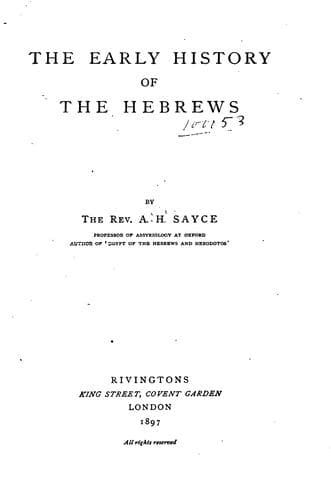
The early history of the HebrewsSayce, A. H. (Archibald Henry)
History
The early history of the Hebrews
Sayce, A. H. (Archibald Henry)
Bible. Old Testament -- Criticism, interpretation, etc.; Jews -- History -- To 953 B.C.
It was not the last time that Mitanni and Egypt were ranged on opposite
sides. Ramses II. claims to have defeated the forces of Mitanni, and the
name of the same country appears among the conquests of Ramses III. of
the twentieth dynasty.[290] It is coupled with Carchemish the Hittite
capital among the kingdoms over which the last of the conquering
Pharaohs had gained a victory. In the great struggle which Egypt had to
face against the Philistines and other piratic hordes from the Greek
seas, the northern invaders had carried with them in their train
contingents from the various peoples of Northern Syria through whose
lands they had passed. The Hittites and Amorites, the inhabitants of
Carchemish and Arvad, even the people of Elishah or Cyprus, joined the
invaders of Egypt, and among the captured leaders of the enemy recorded
on the walls of Medinet Habu are the kings of the Hittites and Amorites.
The king of Mitanni, however, is wanting; enemy though he was of the
Pharaoh, he never ventured into Egypt, and his name therefore does not
appear among the conquered chiefs. All that the Pharaoh could do was to
include the name of his kingdom among those whose forces he had
overthrown.[291]
The reign of Ramses III. brings us to the moment when the Israelites
under Joshua were about to enter Canaan. Egypt had annihilated the
enemies who had invaded it, and had carried a war of vengeance into
Palestine and Syria. The Israelite had not as yet crossed the Jordan.
Among the places in Southern Palestine subdued by Ramses are Beth-Anoth
(Josh. xv. 59), Carmel of Judah, Hebron, Ir-Shemesh, Hadashah (Josh. xv.
37), Shalam or Jerusalem, the districts of the Dead Sea and the Jordan,
even Korkha in the land of Moab.[292] There is as yet no trace of
Israel, and Hebron had not as yet become the spoil of the Kenizzite.
The chronology, however, makes it certain that though the Israelites had
not entered Palestine at the time of the Egyptian campaign in that
country, it could not have been very long before they actually did so.
The campaign of Ramses III., in fact, prepared the way for the
Israelitish invasion by weakening the forces of the Canaanites. In any
case, the victory over the northern nations and their allies,
commemorated in the temple of Medinet Habu, must have taken place only a
few years before the Israelitish conquest of southern Canaan.[293]
Public-domain text, read in full here on John Shaqi.
Reviews
Reviews
No reviews yet
Be the first to share your thoughts on this work.
Elsewhere in the archive
Join the Discussion
Join the discussion
Sign in to leave a comment or review.
Sign InorCreate an account