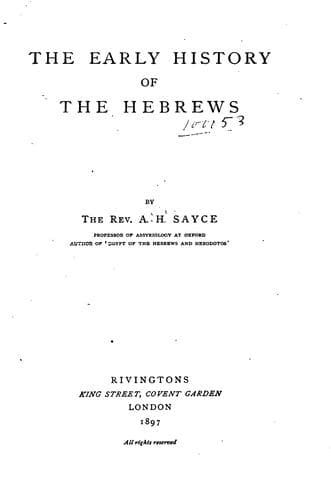
The early history of the HebrewsSayce, A. H. (Archibald Henry)
History
The early history of the Hebrews
Sayce, A. H. (Archibald Henry)
Bible. Old Testament -- Criticism, interpretation, etc.; Jews -- History -- To 953 B.C.
But the history of Samuel is not contained in the book of Judges. We
have to look for it in a new book which records the foundation of the
Israelitish kingdom. The books of Samuel take their name from that of
the prophet which appears on their first page. They begin, however, with
the conjunction ‘And,’ and thus presuppose an earlier volume. They are,
in fact, merely the continuation of the book of Judges. Whether or not
the same compiler has worked at the two books we cannot tell; that is a
question which must be left to the philological critics who have long
since settled his character and date, and determined exactly the limits
of his work.
There is one fact, however, connected with the compilation of the book
of Judges which the historian cannot but notice. The narratives embodied
in it differ from one another in tone and character. The religious point
of view of the stories of Jephthah or Micah is wholly different from
that of the stories of Barak or Jerubbaal. Between the account of the
overthrow of the Canaanites on the Kishon and the stories narrated of
Samson, there is the contrast between written history and folklore. Each
narrative preserves its own individuality, its own point of view, its
own reflection of the age and locality to which it belongs.
Here and there, indeed, the pen of the historian who has collected and
combined these fragments of the past history of Israel can be clearly
traced. The speeches sometimes remind us of those in Thucydides, and
exhibit the colouring of a later age. The framework of the narrative,
moreover, is the writer’s own; in fact, he shows himself to be more than
a compiler; he is a historian as well. But with all this, the narratives
he has collected differ as much in character and tone as they do in the
events they record.
What more convincing proof can we have of the faithfulness with which he
has reproduced his materials? In most cases they have not even passed
through the assimilating medium of his own mind; instead of using his
privilege as a historian he has given them to us unchanged and
unmodified. And yet in many cases they must have shocked both his
religious and his patriotic sense. Whatever else he may have been, the
author of the book of Judges possessed a historical restraint and
honesty which is rare even among the modern writers of Europe. He has
given us the older records of his country just as he found them.
Public-domain text, read in full here on John Shaqi.
Reviews
Reviews
No reviews yet
Be the first to share your thoughts on this work.
Elsewhere in the archive
Join the Discussion
Join the discussion
Sign in to leave a comment or review.
Sign InorCreate an account