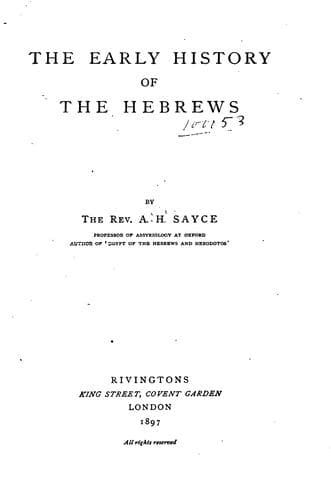
The early history of the HebrewsSayce, A. H. (Archibald Henry)
History
The early history of the Hebrews
Sayce, A. H. (Archibald Henry)
Bible. Old Testament -- Criticism, interpretation, etc.; Jews -- History -- To 953 B.C.
Modern criticism has asked how it is possible that all this could have
been the case if a written Law actually existed. But the question
forgets to take account of the circumstances of the time. A knowledge of
reading and writing was confined to a particular class, that of the
scribes; Israel was divided; intercommunication was difficult, and a Law
which presupposed a camp of nomads continually under the eye of their
legislator, was not adapted to the changed conditions in which the
Israelites found themselves. Moreover, it must be remembered that the
Israelites were for the most part a peasantry living in scattered
villages; the inhabitants of the towns were Canaanites either by race or
marriage. The one were too ignorant, the others too alien, to be
affected by the Mosaic Code.
Nevertheless, the Code was preserved at Shiloh. Here there was an
Aaronic priesthood, and the few notices that we possess of the worship
carried on there show that it was in accordance with the Mosaic Law.
Outside Shiloh, among those who still remained true to the faith of
their fathers, the Law was remembered and presumably observed. Of this
the Song of Deborah is a witness. The God of Israel, in whose name Barak
and Deborah went forth against the heathen, is the Yahveh of the
Pentateuch, not the Baal of Canaan. The history of Israel in the age of
the Judges is, religiously as well as politically, the history of
degeneracy, not of development.
In fact, religion and politics cannot be separated one from the other in
the history of the ancient East, least of all in the history of the
Hebrews. The one presupposes the other, and the political decay of the
nation is a sure sign of its religious retrogression. The same causes
which broke up its political unity broke up its religious unity as well.
The knowledge and worship of Yahveh lingered in Ephraim, because in
Ephraim alone the old ideal and spirit of Israel continued to survive.
Ephraim was, as it were, the heart and core of Israel; it had led the
attack upon Palestine, and its blood was purer than that of the other
tribes. It remained more genuinely Israelite, with less admixture of
foreign blood.
Public-domain text, read in full here on John Shaqi.
Reviews
Reviews
No reviews yet
Be the first to share your thoughts on this work.
Elsewhere in the archive
Join the Discussion
Join the discussion
Sign in to leave a comment or review.
Sign InorCreate an account