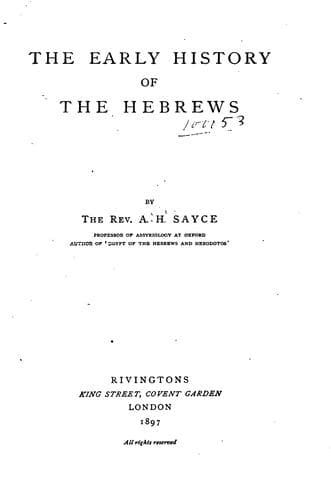
The early history of the HebrewsSayce, A. H. (Archibald Henry)
History
The early history of the Hebrews
Sayce, A. H. (Archibald Henry)
Bible. Old Testament -- Criticism, interpretation, etc.; Jews -- History -- To 953 B.C.
It was while Samuel was still young that the chief Philistine victories
were gained, and as he grew older the Philistine yoke became heavier and
more severe. In the general wreck, his was the one prominent figure in
Israel. To him the people looked for counsel and help, and saw in him a
prophet of Yahveh. But Samuel was a man of peace, not of war. He could
not lead his people to battle, or check the rising tide of Philistine
success. Other men were wanted for the work, and these were not
forthcoming. Perhaps a time came when Samuel himself was unwilling they
should be found, and that the authority he had possessed should pass to
another. Such, at least, is the impression we derive from his opposition
to the demand of the people that they should have a king.
Samuel possessed, moreover, something more than personal influence. He
was the last representative of the ancient sanctuary at Shiloh. He had
been dedicated to it even before he was born; he had grown up in it
among the last descendants of the earlier high-priests; he had seen the
ark taken from it to fall into the hands of the Philistines; he had also
witnessed, probably, the destruction of the temple itself. All the older
traditions of Mosaic worship gathered about him; he was the living link
in the chain which bound the religious past of Israel with its present.
In his person the doctrines and practices which had been preserved at
Shiloh were handed on to the newer age of the kings.
The Hebrew historian who put together the books of Samuel was no longer
embarrassed, like the compiler of the book of Judges, by a want of
materials. His embarrassment arose from a contrary cause. The documents
before him relating to the history of the seer, to the rise of the
monarchy and the adventures of David, were numerous, and the same event
was sometimes recorded in different forms. He was called upon to
harmonise and combine them together, and he doubtless experienced the
same difficulty in doing so that the Assyriologists at present
experience in reconciling the various accounts they have of the history
of Babylonia in the thirteenth century B.C. That the latter can be
reconciled, if only we knew a little more, we cannot doubt; but for the
present the chronological inconsistencies seem irreconcilable. All that
can be done is to set them side by side.
Public-domain text, read in full here on John Shaqi.
Reviews
Reviews
No reviews yet
Be the first to share your thoughts on this work.
Elsewhere in the archive
Join the Discussion
Join the discussion
Sign in to leave a comment or review.
Sign InorCreate an account