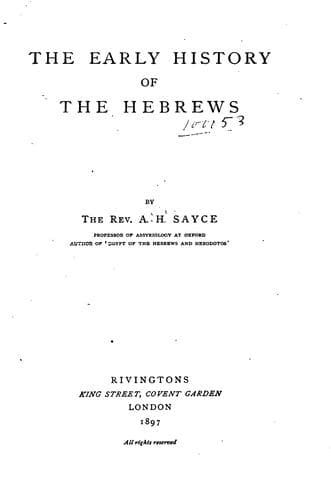
The early history of the HebrewsSayce, A. H. (Archibald Henry)
History
The early history of the Hebrews
Sayce, A. H. (Archibald Henry)
Bible. Old Testament -- Criticism, interpretation, etc.; Jews -- History -- To 953 B.C.
The field was bought from Hamor the father of Shechem, the founder of
the city which was destined to become the seat of the first monarchy in
Israel, and on it was raised the first altar consecrated to the God of
Israel. El-elohê-Israel, ‘El is the God of Israel,’ the altar was
termed, a declaration that the El whom the Canaanites worshipped was the
God of Israel as well. But though the field was bought for one hundred
‘pieces of money’—an expression, be it noted, which is not Babylonian—we
are assured also that Jacob had gained land at Shechem by the right of
conquest. In blessing Joseph he declared to him that to the tribe of his
favourite son there was given ‘a Shechem above’ his ‘brethren which’ he
had taken ‘out of the hand of the Amorite with’ his ‘sword and bow’
(Gen. xlviii. 22); and the story of the ravishment of Dinah recounts how
the sons of the patriarch massacred the men of the city, how they
enslaved their women and carried away their goods. The terrible tale of
vengeance was never forgotten; it is alluded to in the Blessing of Jacob
(Gen. xlix. 5-7), and the disappearance of Simeon and Levi as separate
tribes was looked upon as a punishment for the deed. It would seem that
after the Israelitish conquest of Canaan the population of Shechem
remained half Canaanite, half Israelite,[89] and the Canaanitish
population would naturally remember with horror and indignation the
crime of the sons of Jacob. That the deed should have been attributed to
the ancestors of two of the southern tribes instead of to those of
Issachar or some other tribe of the north is evidence in favour of its
truthfulness.
The sons of Jacob were twelve in number, like the twelve sons of
Ishmael, and corresponded with the twelve tribes of Israel which were
called after their names. And yet the correspondence required a little
forcing. It is questionable whether, at any one time, there ever were
exactly twelve Israelitish tribes. In the Song of Deborah Judah does not
appear at all, Ephraim taking its place and, along with Benjamin,
extending as far south as the desert of the Amalekites, while Machir is
substituted for Manasseh and Gad. Levi never possessed a territory of
its own; had it done so, the tribes would have been thirteen in number
and not twelve. At the same time, it had just as much right to be
considered a separate tribe as Dan, whose cities were in the north as
well as in the south, where, however, they were absorbed by Judah; more
right perhaps than Simeon, which hardly existed except in name. The
territory of Reuben lay outside the boundaries of Palestine, and was
merely the desert-wadis and grazing-grounds of the kingdom of Moab; the
country can be said to have belonged to the tribe only in the sense that
the wadis east of the Delta belong to the Bedâwin, whom the Egyptian
government at present allows to live in them. Manasseh, lastly, was
divided into two halves, in order to bring the number of tribes up to
the requisite figure.
Public-domain text, read in full here on John Shaqi.
Reviews
Reviews
No reviews yet
Be the first to share your thoughts on this work.
Elsewhere in the archive
Join the Discussion
Join the discussion
Sign in to leave a comment or review.
Sign InorCreate an account