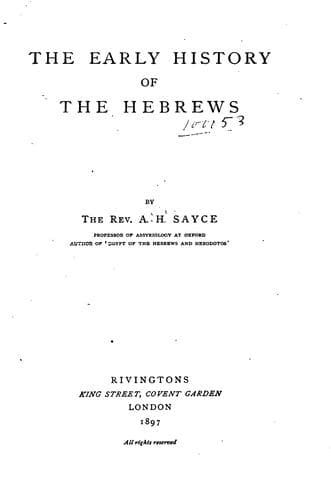
The early history of the HebrewsSayce, A. H. (Archibald Henry)
History
The early history of the Hebrews
Sayce, A. H. (Archibald Henry)
Bible. Old Testament -- Criticism, interpretation, etc.; Jews -- History -- To 953 B.C.
It is clear that the scheme is an artificial one. Israel, after its
conquest of Canaan, could indeed be divided into twelve separate parts,
but such a division was theoretical only. There were no twelve
territories corresponding to the parts, while the parts themselves could
be reckoned as thirteen, eleven, or ten, just as easily as twelve.
The conclusion to be drawn from this is obvious. History credited Jacob
with twelve sons, and it was consequently necessary to bring the number
of Israelitish tribes into harmony with the fact. Modern criticism has
amused itself with reversing the history, and assuming that the twelve
sons of the patriarch owed their origin to the twelve tribes. It has
accordingly drawn inferences from the fact that some of the sons of
Jacob are said to have been the offspring of concubines, and not of his
two legitimate wives, and that Joseph and Benjamin were the youngest of
all. But such inferences fall with the assumption that in the twelve
sons we have merely the eponymous heroes of the twelve tribes. It is a
cheap way of making history, and, after all, what we know of the tribes
does not fit in with the theory. There is nothing in the history of Dan
and Naphtali, or Gad and Asher, which would have caused them to be
regarded of bastard descent, if that bastard descent had not been a
fact; indeed, in the Song of Deborah, which is almost universally
allowed to go back to the early age of the Judges, Naphtali and Zebulun
are placed on exactly the same footing. The distinction between the sons
of Leah and those of Rachel does not answer to the real cleavage between
the tribes of the south and those of the north of Palestine: Benjamin,
after the age of Saul, followed Judah and Simeon, while the sons of
Joseph were joined with Zebulun and Issachar. Moreover, had the sons of
Jacob been mere reflections of the tribes, it would be difficult to
account for the existence of Joseph, or to understand why Machir takes
the place of Manasseh and Gad in the Song of Deborah.
The critical theory is the result of introducing Greek modes of thought
into Semitic history. The Greek tribe, it is true, traced its origin to
an eponymous ancestor, but that ancestor was a god or a hero, and not a
man. Among the Semites, however, as the history of Arabia may still
teach us, the conception of the tribe was something wholly different.
The tribe was an enlarged family which called itself by the name of its
first head. It began with the individual, and to the last styled itself
his children. The Greek tribe, on the contrary, began with the clan, and
its theoretical ancestor, accordingly, was merely the divine personage
whose common cult kept it together. In the Semitic tribe there could be
no cult of its ancestor, for the ancestor was but an ordinary man, who
worshipped the same form of Baal and used the same rites as his
descendants after him.
Public-domain text, read in full here on John Shaqi.
Reviews
Reviews
No reviews yet
Be the first to share your thoughts on this work.
Elsewhere in the archive
Join the Discussion
Join the discussion
Sign in to leave a comment or review.
Sign InorCreate an account