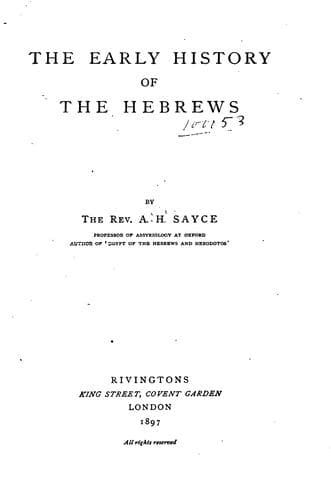
The early history of the HebrewsSayce, A. H. (Archibald Henry)
History
The early history of the Hebrews
Sayce, A. H. (Archibald Henry)
Bible. Old Testament -- Criticism, interpretation, etc.; Jews -- History -- To 953 B.C.
this word no explanation can be found either in Hebrew or in Egyptian.
But the language of the Babylonian inscriptions has unexpectedly come to
our aid. In Chaldæa _abarakku_ was the title of one of the highest
officers of State, and _abriqqu_, borrowed from the earlier Sumerian
_abrik_, signified ‘a seer.’
We have said that the history of Joseph is marvellously true in all its
details to what archæology has informed us were the facts of Egyptian
life. Thus the prison in which ‘the king’s prisoners’ were confined is
called by the strange name of ‘the round house.’ Such, at least, would
seem to be the literal meaning of the Hebrew phrase, the second element
of which signifies ‘roundness.’ The word is written _sohar_, though
there is evidence of another reading, _sokhar_. _Sohar_ or _sokhar_,
however, is really an Egyptian word. The royal prison at Thebes, where
the State prisoners were kept under guard, was: called _suhan_, in which
we have the same interchange of final _r_ and _n_ that is still a
characteristic of Egyptian Arabic.[103] The term _bêth has-sohar_, ‘the
house of the Sohar,’ is found nowhere else in the Old Testament: it is,
in fact, one of the peculiarities which distinguish the story of Joseph,
and at the same time testify to the acquaintance of its writer with the
details of Egyptian life.
The titles of the royal cupbearer and the chief of the bakers have been
found in the lists of Egyptian officials; the Pharaoh’s kitchen was
organised on an elaborate scale;[104] and the Egyptians were famed for
their skill in confectionery and in making various kinds of bread.[105]
On the monuments we may see depicted the cupbearer offering the goblet
of wine, and the baker carrying on his head the baskets filled with
round ‘white loaves.’ The ‘birthday of the Pharaoh’ was a general
festival, on which, as the decrees of Rosetta and Canopus have taught
us, the sovereign proclaimed an amnesty and released such prisoners as
were thought deserving of pardon.[106] The dreams that Pharaoh dreamed
are in full accordance with Egyptian mythology and symbolism. The seven
kine fitly represent the Nile, which from time immemorial had been
likened to a milch-cow. The cow-headed goddess Hathor or Isis watched
over the fertility of the country, and the fertilising water of the
river was called the milk that flowed from her breasts. The number seven
denotes the ‘seven great Hathors,’ the seven forms under which the
goddess was adored. The dreams themselves fall in with the Egyptian
belief of the age. Throughout Egyptian history they have been a power
not only in religion, but in politics as well. It was in consequence of
a dream that Thothmes IV. cleared away the sand from before the paws of
the Sphinx, and a thousand years later Nut-Amon of Ethiopia was summoned
by a dream to invade Egypt. The dreams usually needed an interpreter to
explain them, such as is mentioned in a Greek inscription from the
Serapeum at Memphis.
Public-domain text, read in full here on John Shaqi.
Reviews
Reviews
No reviews yet
Be the first to share your thoughts on this work.
Elsewhere in the archive
Join the Discussion
Join the discussion
Sign in to leave a comment or review.
Sign InorCreate an account