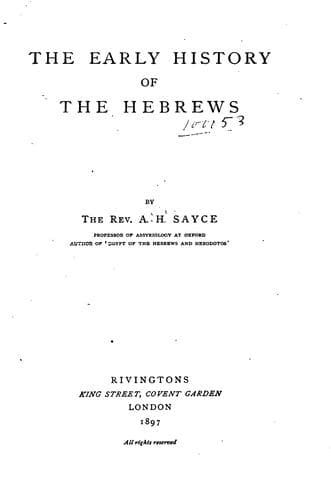
The early history of the HebrewsSayce, A. H. (Archibald Henry)
History
The early history of the Hebrews
Sayce, A. H. (Archibald Henry)
Bible. Old Testament -- Criticism, interpretation, etc.; Jews -- History -- To 953 B.C.
Thus Kharbi-Sipak, a Kassite or Kossæan, from the western mountains of
Elam, is called a ‘Khabirâ’ (W. A. I. iv. 34, 2, 5). The name is
probably connected with that of Khapir or Âpir, originally applied to
the district in which Mal-Amir is situated, south-east of Susa, but
afterwards in the Persian period extended to the whole of Elam (see my
memoir on the _Inscriptions of Mal-Amir_ in the Transactions of the
Sixth Oriental Congress at Leyden, vol. ii.). Kharbi-Sipak himself,
however, seems to have been employed by the Assyrian king in Palestine
in the neighbourhood of the cities of Arqa and Zaqqal (Hommel in the
_Proceedings_ of the Society of Biblical Archæology, May 1895, p.
203).
Footnote 6:
W. A. I. ii. 50, 51 (where Khubur is said to be a synonym of Subarti).
Footnote 7:
W. A. I. ii. 51, 4.
Footnote 8:
Hommel, _The ancient Hebrew Tradition as illustrated by the
Monuments_, pp. 196, 245-262, 323-327; Glaser in the _Mittheilungen_
of the Vorderasiatische Gesellschaft, ii. 1897.
Footnote 9:
K 3500.
Footnote 10:
That _Ebir-nâri_ signified the country west of the Euphrates in the
later days of Babylonian history is shown by a contract-tablet, dated
in the third year of Darius Hystaspis, and translated by Peiser
(_Keilinschriftliche Bibliothek_, iv. p. 305), in which mention is
made of ‘Ustanni, the governor of Babylon and Ebir-nâri’ (line 2).
Meissner (_Zeitschrift für Alttestament_, _Wissenschaft_, xvii.) has
pointed out that Ustanni is the Tatnai of Ezra, v. 3, 6; vi. 6, 13,
who is there called the ‘governor of the land beyond the river’
(_’Abar Nahara_).
Footnote 11:
See Hilprecht, _The Babylonian Expedition of the University of
Pennsylvania_, i. 2, p. 31.
Footnote 12:
An inscription of Sargon recently published by M. Dangin (_Revue
Sémitique_, April 1897) states that ‘the governor’ of the subjugated
Amorites was Uru-Malik, where the name of Malik or Moloch is preceded
by the determinative of divinity. Uru-Malik, which is an analogous
formation to Uriel, Urijah, Melchi-ur (or Melchior), etc., shows that
what we call Hebrew was already the language of Canaan. The
inscription has been found at Tello in Southern Chaldæa.
Footnote 13:
Zabsali, also written Savsal(la) or Zavzal(la), probably represents
the Zuzim or Zamzummim of Scripture. See my article in the
_Proceedings of the Society of Biblical Archæology_, February 1897, p.
74.
Footnote 14:
Public-domain text, read in full here on John Shaqi.
Reviews
Reviews
No reviews yet
Be the first to share your thoughts on this work.
Elsewhere in the archive
Join the Discussion
Join the discussion
Sign in to leave a comment or review.
Sign InorCreate an account