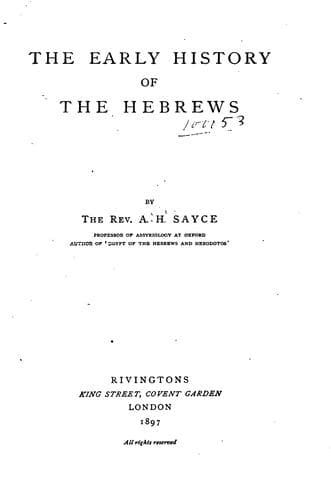
The early history of the HebrewsSayce, A. H. (Archibald Henry)
History
The early history of the Hebrews
Sayce, A. H. (Archibald Henry)
Bible. Old Testament -- Criticism, interpretation, etc.; Jews -- History -- To 953 B.C.
And yet it was just this
narrative, which we are now told bears so plainly on its face the marks
of its late age and sacerdotal character, that hardly twenty years ago
was declared by the critics themselves to be the oldest portion of the
Hexateuch!
By this time the Hexateuch was nearly ready to become the Pentateuch,
which should be read by Ezra before the Jewish community as ‘the law of
God’ (Nem. viii. 8), and be accepted by the hostile Samaritans as alone
authoritative among the sacred books of Israel. All that was needed
further was to combine the existing books into a whole, smoothing over
the inconsistencies between them and supplying links of connection. The
‘final Redactor’ who accomplished this task lived shortly after the
Exile, and has been identified with Ezra by some of the critics. Whoever
he was, he was naturally more in harmony with the spirit and ideas of
the Priestly Code than he was with those of the Prophetic Redaction, or
even of Deuteronomy; indeed, it is hard to understand why he should have
troubled himself about the Prophetic Redaction at all. Between the
Jewish religion of the days of Asa or Jehoshaphat and that of the period
after the Exile a great gulf was fixed.
It is clear that if the modern literary analysis of the Pentateuch is
justified, it is useless to look to the five books of Moses for
authentic history. There is nothing in them which can be ascribed with
certainty to the age of Moses, nothing which goes back even to the age
of the Judges. Between the Exodus out of Egypt and the composition of
the earliest portion of the so-called Mosaic Law there would have been a
dark and illiterate interval of several centuries. Not even tradition
could be trusted to span them. For the Mosaic age, and still more for
the age before the Exodus, all that we read in the Old Testament would
be historically valueless.
Such criticism, therefore, as accepts the results of ‘the literary
analysis’ of the Hexateuch acts consistently in stamping as mythical the
whole period of Hebrew history which precedes the settlement of the
Israelitish tribes in Canaan. Doubt is thrown even on their residence in
Egypt and subsequent escape from ‘the house of bondage.’ Moses himself
becomes a mere figure of mythland, a hero of popular imagination whose
sepulchre was unknown because it had never been occupied. In order to
discredit the earlier records of the Israelitish people, there is no
need of indicating contradictions—real or otherwise—in the details of
the narratives contained in them, of enlarging upon their chronological
difficulties, or of pointing to the supernatural elements they involve;
the late dates assigned to the medley of documents which have been
discovered in the Hexateuch are sufficient of themselves to settle the
question.[127]
Public-domain text, read in full here on John Shaqi.
Reviews
Reviews
No reviews yet
Be the first to share your thoughts on this work.
Elsewhere in the archive
Join the Discussion
Join the discussion
Sign in to leave a comment or review.
Sign InorCreate an account