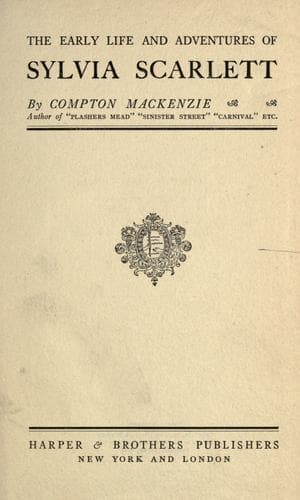
The Early Life and Adventures of Sylvia ScarlettMacKenzie, Compton
General
The Early Life and Adventures of Sylvia Scarlett
MacKenzie, Compton
Fiction
Why could he not have said that at first, Sylvia thought. She would have
been so quickly generous if he had, but the preface about her being
married had spoiled his concession. He was a curious creature, this
husband of hers. When they were alone he would encourage her to be as
she used to be; he would laugh with her, show the keenest interest in
what she was reading, search for a morning to find some book that would
please her, listen with delight to her stories of Jimmy Monkley or of
her father or of Blanche, and be always, in fact, the sympathetic
friend, never obtruding himself, as lover or monitor, two aspects of him
equally repugnant to Sylvia. Yet when there was the least likelihood not
alone of a third person's presence, but even of a third person's hearing
any roundabout gossip of her real self, Philip would shrivel her up with
interminable corrections, and what was far worse, try to sweeten the
process by what she considered fatuous demonstrations of affection. For
a time there was no great tension between them, because Sylvia's
adventurous spirit was occupied by her passion for knowledge; she felt
vaguely that at any time the moment might arrive when mere knowledge
without experience would not be enough; at present the freedom of
Philip's library was adventure enough. He was most eager to assist her
progress, and almost reckless in the way he spurred her into every
liberty of thought, maintaining the stupidity of all conventional
beliefs--moral, religious, or political. He warned her that the
expression of such opinions, or, still worse, action under the influence
of them, would be for her or for any one else in the present state of
society quite impossible; Sylvia used to think at the time that it was
only herself as his wife whom he wished to keep in check, and resented
his reasons accordingly; afterward looking back to this period she came
to the conclusion that Philip was literally a theorist, and that his
fierce denunciations of all conventional opinions could never in any
circumstances have gone further than quarreling with the vicar and
getting married in a registry-office. Once when she attacked him for his
cowardice he retorted by citing his marriage with her, and immediately
afterward apologized for what he characterized as "caddishness."
"If you had married me and been content to let me remain myself," Sylvia
said, "you might have used that argument. But you showed you were
frightened of what you'd done when you sent me to Hornton House."
"My dear child, I wanted you to go there for your own comfort, not for
mine. After all, it was only like reading a book; it gave you a certain
amount of academic theory that you could prove or disprove by
experience."
"A devil of a lot of experience I get here," Sylvia exclaimed.
"You're still only seventeen," Philip answered. "The time will come."
"It will come," Sylvia murmured, darkly.
"You're not threatening to run away from me already?" Philip asked, with
a smile.
Public-domain text, read in full here on John Shaqi.
Reviews
Reviews
No reviews yet
Be the first to share your thoughts on this work.
Elsewhere in the archive
Join the Discussion
Join the discussion
Sign in to leave a comment or review.
Sign InorCreate an account